
A rivalry 21 years in the making, and a glimpse of what the A-League could become
South Melbourne were left behind when Australian soccer reinvented itself in 2005. Now, with a historic (and sold-out) cup final looming on Saturday night, their case for inclusion has never looked more compelling.
First reported 4 hours ago · latest update 4 hours ago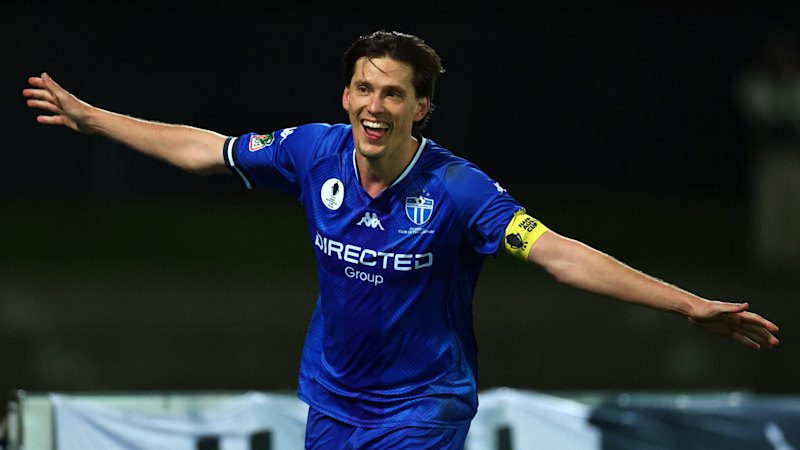
A-League chief executive Steve Rosich’s seven-word answer to a question that Australian soccer has wrestled with for decades offers a tantalising glimpse into a future that, not so long ago, seemed unthinkable.
Will South Melbourne Hellas’ Greek heritage count against them in their latest attempt to return to the top flight?
“It’s certainly not something I think about,” Rosich told this masthead.
That sounds like poetry to South Melbourne Hellas co-president Bill Papastergiadis, who wants his club to become a “Trojan horse” for all the fallen giants of the old National Soccer League, and indeed, any other club across the country with aspirations to play at the highest level.
“It’s refreshing,” he said.
“It’s the first time I’ve actually heard that it’s not an issue. It’s a positive step, and one which we embrace.”
On Saturday night, South Melbourne will face Melbourne Victory in an Australia Cup final that is about much more than a trophy. A sold-out AAMI Park will host the first competitive meeting between two clubs that represent opposite sides of Australian soccer’s great divide: one a powerhouse of the old NSL, the other among the most successful products of the A-League era.
The creation of the A-League in 2005 under Frank Lowy’s Football Federation Australia was a much-needed reset after the slow, painful demise of the NSL, ushering in a bold commercial era for the sport - but it also deliberately broke with the past, replacing clubs closely associated with the migrant communities that had built Australian soccer with broad-based franchises designed to attract mainstream support.
The extraordinary appetite for this occasion, with tickets snapped up within 48 hours of going on sale, has reignited debate over whether clubs like South Melbourne should have been left behind in the first place, and how that divide can be bridged.
Spat out into the Victorian system when the A-League launched, and forced to watch Victory take their place as the state’s leading club, South Melbourne have spent the past 21 years agitating for a return to the national stage, sometimes with an air of entitlement that suggested their illustrious history should have been enough to get them in.
Papastergiadis led their last bid for an A-League licence in 2018, when FFA overlooked South in favour of Western United and its promise of a privately funded stadium for a supporter base that had also yet to be built on Melbourne’s western fringes.
“I was told, ‘Bill, great bid. We loved what you did. We love what you offered. But we couldn’t knock back new stadium infrastructure for football in this country, and that was the determining factor for us,’” he recalled.
“Well, we know how that ended up.”
South Melbourne argued they not only had a ready-made fanbase, but a generous, long-term deal at an existing venue: Lakeside Stadium. Papastergiadis said the arrangement enables them to break even on crowds of little more than 1000, in contrast with many A-League clubs, which pay through the teeth to access their stadiums.
Even though it wasn’t said by FFA, the club’s suspicion was that, once again, their “ethnic club” status counted against them.
But if the Lowy era of Australian football administration gave clubs like South Melbourne the cold shoulder, the sport’s custodians today appear more willing to hear them out.
The day after the Australian Professional Leagues formally ended Western United’s participation in the competition, South Melbourne publicly declared their intention to try again. This time, the atmosphere has changed. The A-League’s slide away from mainstream relevance has made the appeal of a club like South Melbourne, and the prospect of regular high-stakes rivalry matches against clubs like Victory, much clearer; the things that once counted against them may no longer matter if they can enhance the product and grow the pie.
South’s own recent transformation has made their case more compelling. Last year, they narrowly avoided relegation from the Victorian NPL, which would have been an unprecedented disaster for a club that has not dipped below Victoria’s top division since 1961, their second season of existence. A personal investment of over $500,000 from Papastergiadis and co-president Andrew Mesourouni helped save them from the drop, accelerating a professional overhaul that positioned them for success in two new competitions.
South Melbourne spearheaded the creation of the second-tier Australian Championship, which they won last year (the new season begins next weekend), while they also reached the final of the inaugural OFC Pro League, a circuit-style roadshow played in centralised locations across Oceania. Throw in their NPL commitments and extraordinary run to the Australia Cup final, and they have become one of the busiest clubs in Australia this year, playing more than 50 competitive matches - almost the length of two full A-League seasons.
More importantly, they have begun building the infrastructure of a professional club - better players, bigger budgets, greater revenue, smoother off-field operations - rather than waiting for an A-League licence to give them a reason to do so.
The ultimate goal, however, remains unchanged: a full-time place in Australia’s national league. Even if they beat Victory in the final, the prize on offer is not automatic promotion; by their own admission, a move into the A-League remains some way off.
Rosich admires South Melbourne’s ambition but is making no promises.
“They’ve done a great job in promoting their club and delivering on the field in their competitions, and they’ve got a great opportunity to showcase that against Melbourne Victory on Saturday,” Rosich said.
“There’s a considered process that South Melbourne will go through. There’s no discussions at this point in time, there’s simply a registered interest. Pleasingly, we have interest from different parties looking to enter the league in different markets. Our board will go through, in time, what are the right markets for expansion, who are the right parties to initiate that expansion with, and under what circumstances and timing.”
Some of those other interested groups, according to sources familiar with the A-League’s expansion landscape, include consortiums based in south-east Queensland and Christchurch, as well as the new owners of A-League Women side Canberra United, who have an exclusive option to form a men’s team in the capital in the 2028-29 season - although it is unlikely any teams besides Canberra will be added until the season after that, when the new broadcast rights deal will begin.
The asking price for a licence to play in the A-League is about $15 million, according to sources not authorised to comment publicly.
Even if South Melbourne can find that money, there is also the challenge of funding an ongoing A-League operation: Papastergiadis estimates their annual budget of $3.5 million would need to double, but believes the club’s existing stadium arrangements and commercial growth prospects give it a head start.
For all that separates South Melbourne and Melbourne Victory, they have spent the last 21 years becoming more like each other.
Victory, often derided as a “plastic” club like the others created for the A-League, have developed a patina of history and tradition. South, meanwhile, have become a slicker, more professional enterprise without surrendering the Greek identity that has always been central to their existence. They still proudly call themselves Hellas, and Greek surnames still dominate their boardroom, but their appeal has never been confined to one community.
To Papastergiadis, Rosich’s words suggest South Melbourne may finally be judged on their merits rather than their origins.
“South Melbourne has a rich history, one which we celebrate ... but at the same time, when players or coaches sign up for the club, we don’t ask them where their mother was born,” Papastergiadis said. “It’s about time that football caught up with mainstream society. Heritage and history are an important part of who we are, but not sole determinants of where we’re going.”
There is genuine animosity between these two clubs and their supporters, and Saturday night promises plenty of it. But there is also shared DNA: Ange Postecoglou, Paul Trimboli and Kevin Muscat are among the figures who have shaped both organisations, while players, coaches and fans have crossed or straddle the divide. It’s complicated, a bit messy, and precisely the kind of derby Australian soccer has spent years trying to manufacture when it could have been harnessing what was already there.
Debate will rage over whether this really is the biggest match in Australian domestic soccer history, but it would be one of South Melbourne’s greatest achievements if they can spring an upset.
If they do, they intend to honour it permanently.
Above the club’s logo sit four golden stars, representing their four NSL titles: 1984, 1991, 1998 and 1999. The club is still debating whether last year’s inaugural Australian Championship triumph warrants a fifth.
Should they beat Victory on Saturday night, the decision has been made.
“It’s our fifth star,” Papastergiadis said. “That’s how important it is for us.”
You have reached your maximum number of saved items.
Remove items from your saved list to add more.
You've used all of your gift articles. 3 more will become available on the 1st of every month.
Citations · 2 reports from 2 outlets
Tap a citation to read it above, right here on T.A.M.
A rivalry 21 years in the making, and a glimpse of what the A-League could become
South Melbourne were left behind when Australian soccer reinvented itself in 2005. Now, with a historic (and sold-out) cup final looming on Saturday night, their case for inclusion has never looked more compelling.
4 hours ago · Vince RugariA rivalry 21 years in the making, and a glimpse of what the A-League could become
South Melbourne were left behind when Australian soccer reinvented itself in 2005. Now, with a historic (and sold-out) cup final looming on Saturday night, their case for inclusion has never looked more compelling.
4 hours ago · Vince Rugari