
Work is under way to craft Brisbane’s identity. Who and what will define it?
Brisbane is about to plug into the largest brand-building, identity-shaping machine on the planet – the Olympics. So what do we want to say about our city?
First reported 3 hours ago · latest update 3 hours ago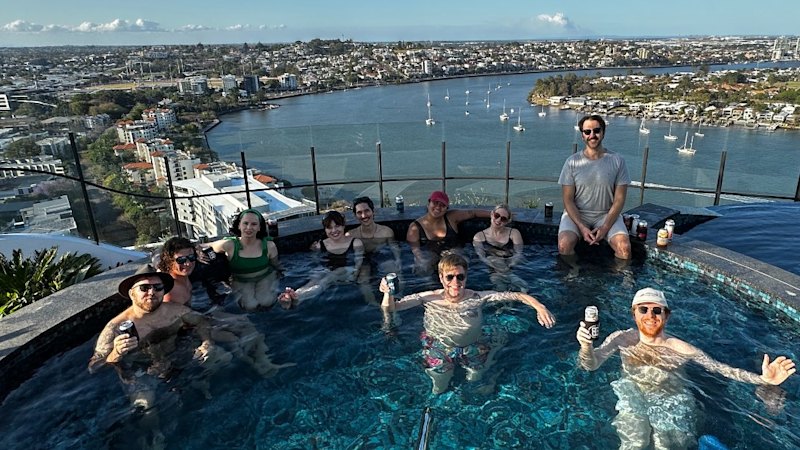
Stepping into the airconditioned Rivershed at Howard Smith Wharves brings relief from the sticky day outside. But not long after sitting down inside, the 150-odd politicians, powerbrokers and other members of Queensland’s business elite are up on their feet again.
It’s the King’s Birthday public holiday in Queensland, and Lord Mayor Adrian Schrinner is wearing his green Adidas sneakers.
“Are you ready Brisbane City? Are you ready surrounding suburbs?” entertainer Neridah Waters asks the crowd from the stage, where she stands dressed in a spangled leotard.
She leads the room in a dance to the Starship hit We Built This City, with local lyrics and choreography to match: think the “Sherwood shimmy” and the “Camp Hill clicks”, followed by the “Paddington punch”, the “Red Hill roll” and the “Fortitude Valley party pelvis”.
This is a snapshot of the Brisbane that Olympic organisers want to share with the world: a city that says “yes”, with a relaxed, cheeky, and friendly spirit.
The Committee of Brisbane’s lunch event, themed around Brisbane’s brand positioning, is meant to come just hours after a big reveal of the 2032 Olympic and Paralympic emblems. An unfortunate YouTube leak days earlier changes the tone, but doesn’t dampen the spirit in the room.
Former South Bank chairman Steve Wilson and his company-director wife, Jane, who have poured millions into restoring their historic Kangaroo Point mansion – and who first proposed the new 63,000-seat Olympic stadium at Victoria Park – are among the room’s most enthusiastic dancers.
Others spotted around the tables are Raynuha Sinnathamby, daughter of rich lister and mastermind of the Greater Springfield development Maha Sinnathamby; co-owner of James Street’s Calile Hotel, Catherine Malouf; Olympian turned millionaire property developer Mark Stockwell; and Harvey Lister, head of ASM Global, which operates Suncorp Stadium.
Brisbane will be the smallest city since Helsinki in 1952 to host a summer Olympics.
Ask people overseas what they know of Australia and they might list kangaroos, koalas, the Sydney Harbour Bridge, the Opera House and perhaps Uluru. Fewer can name Brisbane.
Tourism Australia’s latest major ad campaign, fronted by south-east Queensland’s own Robert Irwin and an animated toy kangaroo, snubs Brisbane entirely for shots of the Great Barrier Reef, South Australia’s Eyre Peninsula and a Margaret River winery.
But Lord Mayor Adrian Schrinner insists Brisbane punches above its weight.
“Yes, we’re friendly, yes we’ve got a great climate, but this is a truly innovative go-ahead place and a resilient place and also one that says yes to things, gives things a go,” Schrinner says.
Work to craft a new identity for Brisbane began three years ago when the Olympic organising committee surveyed 3000 people, both here and overseas. They were asked what they thought of the Queensland capital, what they would want it to be remembered for, and what would make them want to come here.
Brisbane Olympics president Andrew Liveris spruiks the city as one of the friendliest in the world – it was the only Australian city to feature in Time Out’s top 20 friendliest cities list last year. But he mainly defines it as a “lifestyle superpower”.
“We should really let the world know about that, so that they can come and be part of it,” he says.
Brisbane averages more than 230 days of sunshine each year, with about 110 of those bluebird days with barely a cloud in sight.
It boasts one of the youngest populations out of Australia’s major cities – the median age here is 36.5 – and is the nation’s fastest growing capital city.
Ninety-two per cent of Brisbane residents rate their overall quality of life highly.
“Millions and millions of visitors are heading our way. Billions more will tune in ... and witness the wonders firsthand of what we have to offer: our incredible environment and nature that we care about, our warm and our welcoming people … [and] our absolute love of sport,” Liveris says.
“Brisbane is having a moment.”
As Griffith University Associate Professor of Marketing, Gavin Northey, puts it: “Brisbane is about to plug into arguably the largest brand-building, identity-shaping machine on the planet.”
Get it right and Brisbane’s potential economic opportunity from the Olympics is $70 billion over the 20 years from 2032-2052, according to an analysis from Deloitte.
But Northey says the city absolutely needs its own identity, “because without it, it’s just Australia, but not Sydney”.
Williams, the Committee for Brisbane chief executive, agrees.
“For a long time, Brisbane was defined by a comparison to other cities,” she says. “Today, we’re at a point where we can confidently define ourselves on our own terms.”
A history of recent attempts in brand positioning gives some clues on what might resonate, and what to avoid.
Brisbane was still in the long shadow of the Fitzgerald inquiry into political and police corruption when the nickname “Brisvegas” emerged in the mid-90s, as a tongue-in-cheek comparison of the city’s historically quiet, sleepy nightlife with the glitz and 24-hour excitement of Las Vegas.
By 2009, then-lord mayor Campbell Newman was trying to shed that image, launching Brisbane’s “new world city” campaign.
More recently, Tourism Queensland enlisted beloved cartoon character Bluey and Robert Irwin to put the Sunshine State on the international map. In the campaign’s television commercial, Irwin asked: “Ever wished you could live in Bluey’s world for real life?”
But ask Associate Professor Monica Chien, an expert in destination branding at the University of Queensland, and she’ll tell you Brisbane’s identity is still evolving.
“That is both its challenge and its opportunity,” she says.
When asked what words come to mind when she thinks of Brisbane, Chien replies: “Subtropical, friendly, diverse, liveable, relaxed, optimistic, sustainable, emerging.
“I see Brisbane as an optimistic, subtropical and outward-looking city. It is a city that values openness, creativity, entrepreneurship, and quality of life, while increasingly positioning itself as a global leader in areas such as clean technologies, education, research, advanced industries, and sustainable urban development.”
Her response taps into some common themes. Last year, Premier David Crisafulli told the Australian Financial Review Magazine he associates Brisbane with the words “liveable, warm, emerging”.
Williams uses the words: “Optimistic, friendly, liveable, desirable, authentic, happy, fun, innovative, welcoming, curious.”
To an outsider, she poetically describes Brisbane as a modern city with “the energy and opportunity of a major global centre, but with sunshine, a river at its heart, and a culture that values balance as much as ambition”.
Northey lists “the climate, the river, the outdoor living, First Nations culture and a sense of humour about ourselves” to describe the city.
“Brisbane’s identity is probably something like subtropical, outdoor, unpretentious and quietly ambitious, where life is warm, fun and a bit cheeky,” he says.
But, he adds, the brand has to match what people actually experience when they get off the plane.
“If the ad promises paradise and the reality is a traffic jam, you’ve built a broken promise, not a brand,” he says.
“Research on brand equity shows a brand is essentially the set of associations people carry in their heads, and those associations quietly drive big decisions, like where to holiday, study, invest or build a career.
“Brisbane has a blank canvas and it is getting this opportunity in front of billions of people to make a killer first impression.”
Limited awareness of Brisbane outside Australia is not necessarily a weak starting point, Chien says.
“In many ways, it provides greater flexibility. Brisbane has the opportunity to actively define its future identity rather than being constrained by historical perceptions,” she says.
Queensland Sport and Olympics Minister, and self-described Brisbane boy, Tim Mander, says: “Our city and our state are really coming of age.”
However, Brisbane has seemingly been coming of age for decades – first during the Commonwealth Games in 1982, then with World Expo in 1988, and many moments thereafter.
“City-building is a long-term endeavour,” concedes Williams.
“The most successful city brands are not created for visitors or investors alone. They are embraced by the people who call the city home.”
Start the day with a summary of the day’s most important and interesting stories, analysis and insights. Sign up for our Morning Edition newsletter.
You have reached your maximum number of saved items.
Remove items from your saved list to add more.
You've used all of your gift articles. 3 more will become available on the 1st of every month.
Citations · 2 reports from 2 outlets
Tap a citation to read it above, right here on T.A.M.
Work is under way to craft Brisbane’s identity. Who and what will define it?
Brisbane is about to plug into the largest brand-building, identity-shaping machine on the planet – the Olympics. So what do we want to say about our city?
3 hours ago · Marissa CalligerosWork is under way to craft Brisbane’s identity. Who and what will define it?
Brisbane is about to plug into the largest brand-building, identity-shaping machine on the planet – the Olympics. So what do we want to say about our city?
3 hours ago · Marissa Calligeros