
Interactive: The Australian cities paying the most – and least – for beer
Buying a round of beers will punish your wallet in some cities more than others. Use our interactive to see how much the cost of your favourite froth has risen over time.
First reported 2 hours ago · latest update 2 hours ago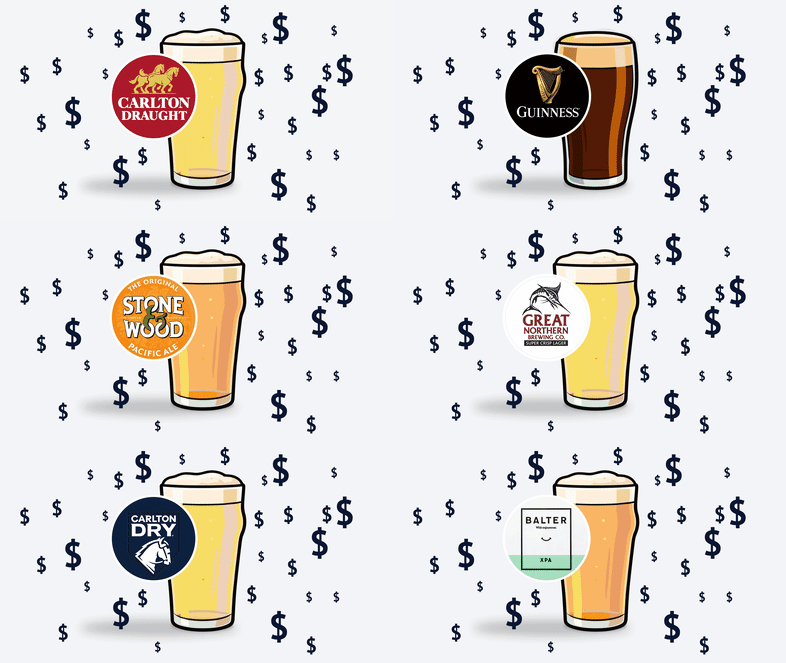
You have reached your maximum number of saved items.
Remove items from your saved list to add more.
You've used all of your gift articles. 3 more will become available on the 1st of every month.
If you’ve ever done a double-take at the cost of buying a round of beers for your mates at the pub these days, your complaints have been justified: since January 2020, the average price of a pint of beer has risen by nearly $1 every 18 months, or from $9.96 to $13.76 across the nation.
And if you’re in Melbourne, tough luck; you’re typically paying more than the rest of the country for Australia’s favourite beers, according to exclusive data provided by Square.
Click on the interactive below to see how prices compare for your beer of choice across capital cities. Some pricing information is missing due to insufficient data in some cities, including Carlton Dry and Carlton Draught in Brisbane, and Carlton Draught and Balter XPA in Adelaide. City-level pint comparison data for VB, Asahi, Furphy and Heaps Normal was incomplete and has been excluded from the final data set.
A pint of Balter XPA costs more in Melbourne ($15.70) than any other Australian city on average. The same goes for Guinness ($15.51), Carlton Draught ($13.91), Carlton Dry ($12.86) and Great Northern Super Crisp ($12.95).
Meanwhile, the opposite is true for those who live in Perth, which is generally the cheapest capital city to buy a pint of those beers.
“That to me suggests [those beers are] trying to do some sort of targeted discounting or trying to break in to the Western Australia market,” said beer expert and The Crafty Pint founder James Smith. “WA as a whole, in terms of hospitality and the beer production industry, has generally held firm longer than other states did.”
The steepest increases came after pandemic lockdowns ended in 2022, after which most pint prices rose by about 10 per cent, said Square executive David Schnabl.
“Most [pubs] held prices for as long as they could, which is why pub beer may have felt like it lagged the grocery aisle in the early inflation years,” he said. “Increases have moderated every year since, but they’ve never reversed.”
The national average price of premium beers Balter XPA ($14.53) and Guinness ($14.48) have been drifting towards the $15 mark.
“Craft beer was already trading at a premium, but the gap between premium and mainstream has continued to widen. The $10 pint is effectively extinct in this dataset,” said Schnabl. “Even XXXX Gold, the cheapest pint of any beer we tracked, now averages $11.24 nationally.”
Stone & Wood Pacific Ale tends to be the most consistently priced across the country, with less than $1 difference between the cheapest and most expensive city, Sydney ($14.25) and Adelaide ($15.23).
Residents of Adelaide, where Coopers Brewery originated, are paying more than others to drink a Coopers Pale Ale at $13.81 (with the exception of Perth).
A pint of Great Northern ($11.73), Australia’s best-selling beer, has risen more than any other major tap beer, at 43 per cent since 2020, when it was $8.21. Guinness (which has enjoyed a cultural resurgence thanks to the viral trend of “splitting the G”) is not far behind, increasing 41 per cent from $10.25 to $14.48 a pint.
Let us know in the comments.
Publicans in Victoria are grappling with more levies and taxes than those in some other states, including the mental health wellbeing levy and the COVID-19 debt repayment payroll tax, which impact venues where payroll exceeds $10 million. Meanwhile, higher land tax and council rates as well as stricter licensing conditions, which include a mandatory guard-to-patron ratio for late night venues, have also pushed up overheads and squeezed margins.
“I certainly hear my mates who’ve got pubs say: ‘They’re f---ing killing us here,’” said Smith.
But the popularity of Carlton Draught as the state’s most ordered tap beer endures.
“I reckon there could be an element in Victoria or in Melbourne, people knowing we can charge more because people are going to buy it anyway. They might walk away from the bar and go, ‘I can’t believe how much it’s cost me for a round’, but they’re never going to look at anything else on tap.”
Perth’s prices also appear cheaper as there’s a more “entrenched pint culture” on the west coast than the east coast, according to Titanium Property food and retail planning expert Taylor Westlake. About 8 per cent of greater Perth’s population was born in England, where pints are the standard beer size (570ml), compared with greater Sydney’s 2.9 per cent. A schooner (425ml) is the default drink size in NSW.
“Pints are charged at a premium in NSW and Queensland, compared to the base price of a schooner (425ml),” said Westlake. “In Perth, its more common for a pint to be the base beer price – the fact they are more common could have kept its price down over time.”
And in South Australia, a “pint” measures at 425ml, which is a schooner everywhere else; and if you order a schooner in Adelaide, you’ll get a Sydney middy (285ml).
Australia has the world’s third-highest alcohol tax rate in the world. One of the biggest factors pushing up beer prices is the twice-yearly alcohol excise increase, which is tied to inflation.
Since 2000, beer prices have risen by about 27 per cent after general inflation has been factored in, according to AMP analysis.
“In Australia prices have gone up by 113 per cent over the period, but beer prices have gone up a lot more, meaning that’s a real increase in beer prices,” said AMP economist My Bui. “In other words, the nominal increase in beer prices is almost 170 per cent, [so] the real change in beer prices has been about 27 per cent.”
Last year, Prime Minister Anthony Albanese made much noise of taking the pressure off beer prices by freezing the excise on draught beer for two years. “[It’s] a commonsense measure that is good for beer drinkers, good for brewers and good for pubs,” he said in March last year.
But the temporary freeze is only for the draught (or tap) beer market, 90 per cent of which is controlled by the two foreign Big Alcohol multinationals: Lion, a subsidiary of $21 billion Japanese beverage conglomerate Kirin, and CUB, a subsidiary of Japanese rival Asahi.
“All the freeze is doing is giving producers a little breathing room to either not increase prices or to absorb the cost. It will not have any impact on the cost and/or price of beer now,” said Independent Brewers Association chief executive Kylie Lethbridge.
“While [the freeze] would provide some relief to excise-paying independent breweries, the benefit would predominantly go to the big multinationals.”
Independent senator David Pocock caused a stir on social media this year when he forced a government official to admit that the amount of revenue raised from beer (nearly $3 billion) was more than how much the gas industry pays in tax (less than $2 billion).
The pace of pint price rises is starting to ease to 2.7 per cent this year to date, the first sub-3 per cent rise since COVID, but don’t expect to pay less at the pub this summer.
“Easing isn’t the same as stopping,” said Square’s Schnabl. “The national [pint price] average could hit $14 around late 2027.
“If wages and energy stabilise, we may see price increases moderate further, but a reversal is unlikely.”
The Business Briefing newsletter delivers major stories, exclusive coverage and expert opinion. Sign up to get it every weekday morning.
Citations · 2 reports from 2 outlets
Tap a citation to read it above, right here on T.A.M.
Interactive: The Australian cities paying the most – and least – for beer
Buying a round of beers will punish your wallet in some cities more than others. Use our interactive to see how much the cost of your favourite froth has risen over time.
2 hours ago · Jessica YunInteractive: The Australian cities paying the most – and least – for beer
Buying a round of beers will punish your wallet in some cities more than others. Use our interactive to see how much the cost of your favourite froth has risen over time.
2 hours ago · Jessica Yun