
How a rebel force held the world to ransom in a single night of chaos and panic
In a matter of hours, an Iran-allied militia trounced Saudi-backed forces to take control of Yemen’s Red Sea coast. No one was able – or willing – to stop them.
First reported 1 day ago · latest update 1 day ago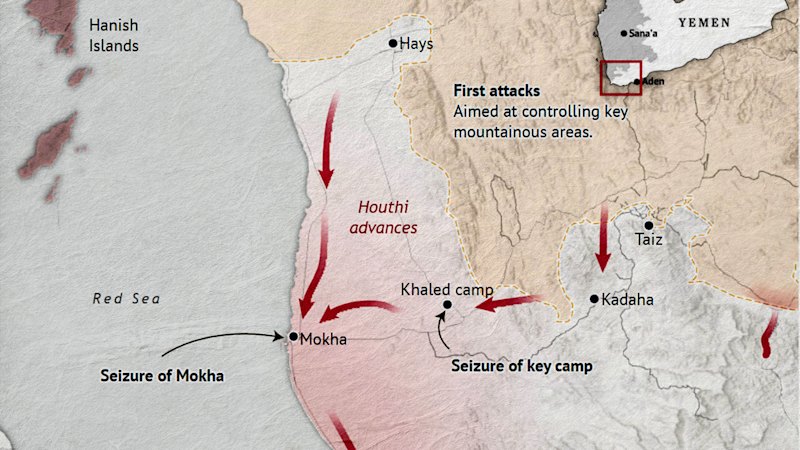
When the US and Israel attacked Iran in February, the Houthis appeared willing at first to sit out the war. But behind the scenes, Yemen’s truce had become a brittle stalemate.
Talks aimed at a long-term peace deal – from which the Houthis hoped to gain greater authority and access to oil revenue – had stalled. Poverty in Houthi territory was dire, putting pressure on the group. They blamed Saudi Arabia and bristled at Saudi restrictions on Yemeni airspace.
The tensions came to a head in July. The Houthis accused Saudi Arabia of bombing Sanaa’s airport to prevent an Iranian aircraft from landing. They declared a blockade on Saudi shipping in the Red Sea, now a crucial route for oil exports during the Iran war. They launched missiles and drones into Saudi Arabia, and the kingdom launched airstrikes on Yemen.
This escalation dovetailed with the interests of Iran, where officials were pushing to widen the war with the US, raising its costs for President Donald Trump.
As the Houthis put pressure on oil markets, some Yemeni government officials sensed an opportunity to solicit foreign support to fight the Houthis.
Clashes reignited inside Yemen, and Houthi officials accused Saudi Arabia and their Yemeni allies of preparing a new offensive against them. Quietly, the militia readied its own plans.
On August 9, the Houthis began to shower Mokha with missiles and drones, damaging the port and seeking to cut off the city’s supply line from the sea, according to two Yemeni military officers. Then, on September 3, the Houthis began a huge ground offensive.
A 39-minute video released by the Houthis, which they said was filmed during fighting for control of the Red Sea coast, shows their militiamen scaling rugged mountains on foot and waving guns in jubilation.
The video, which the Times was unable to independently verify, also shows the bodies of what appear to be Yemeni government fighters slumped inside vehicles. At the end, a toothless Houthi fighter vows to “pursue the enemy into their very lairs”.
For more than five days, the government force held off the militia, battling in the mountains above Mokha. Eventually, the Houthis were able to push forward, with an onslaught of missiles, drones and shelling. Saudi Arabia carried out only minimal airstrikes to assist its Yemeni allies, according to the two Yemeni military officers.
On the evening of September 9 and into the next morning, the government forces collapsed. In a flurry of confusion, they beat a rapid and disorganised retreat. The Houthis seized a major military camp in the foothills east of Mokha – leaving their enemies on the coastal plain exposed and vulnerable.
Instead of reorganising, the government’s soldiers withdrew all the way to the southern city of Aden, handing the entire Red Sea coast, including an island inside the Bab el-Mandeb Strait, to the Houthis.
Overnight, Yemen’s government had lost more than 4500 square kilometres of territory. At least 500 of Saleh’s fighters were killed and more than 1500 wounded, according to a statement by his group. The Houthi death toll is unknown.
Soon after Mokha fell, Saleh and several of his comrades flew to the Saudi capital of Riyadh, according to one of the Yemeni government officials and two of the military officers. There, they decamped to a five-star hotel, where easy listening music echoed through a cavernous lobby and servers brought tea with madeleines.
One of the military officers, who is close to Saleh, told a Times reporter that he was now focused on regrouping his forces and treating the wounded. Eventually, there will be an investigation into what went wrong, he said.
In Yemen, Saleh’s soldiers have scattered. Some were left stranded outside Aden after fighters from other factions – ostensibly their allies – barred them from the city, according to the officer close to Saleh and another soldier. Speaking by phone from their makeshift encampment, that soldier said that they had gone days without food.
In public statements, the Houthis sought to reassure the international community that they posed no threat to maritime security – only to Saudi Arabia, one of the world’s largest exporters of oil.
As oil prices surged above $US100 a barrel, the Houthis began pushing to expand their territory further, promising to “liberate” all of Yemen.
Last weekend, the Yemeni government’s leader, Rashad al-Alimi, declared a full-blown war against the militia. The government’s goal, he said, was to reclaim all the territory lost to the Houthis over the past 12 years.
For Yemeni civilians, already facing dire poverty and hunger, the war’s return portends deeper suffering. More than 180,000 people have been displaced in recent weeks, often piling onto pick-up trucks and motorcycles as they rushed to escape.
“The moment felt like doomsday, with everyone looking out for themselves,” said Hassan Sughair, a civilian who fled from a town near Mokha. “We did not even say goodbye to our neighbours, and we do not know what happened to them.”
This article originally appeared in The New York Times.
Get a note directly from our foreign correspondents on what’s making headlines around the world. Sign up for our weekly What in the World newsletter.
Citations · 2 reports from 2 outlets
Tap a citation to read it above, right here on T.A.M.
How a rebel force held the world to ransom in a single night of chaos and panic
In a matter of hours, an Iran-allied militia trounced Saudi-backed forces to take control of Yemen’s Red Sea coast. No one was able – or willing – to stop them.
1 day ago · Vivian Nereim, Saeed Al-Batati, Shuaib AlmosawaHow a rebel force held the world to ransom in a single night of chaos and panic
In a matter of hours, an Iran-allied militia trounced Saudi-backed forces to take control of Yemen’s Red Sea coast. No one was able – or willing – to stop them.
1 day ago · Vivian Nereim, Saeed Al-Batati, Shuaib Almosawa