
Nightingale is revered in Melbourne. Its creator says it won’t fix the housing crisis
In a lecture theatre inside one of Melbourne’s premier design schools, Jeremy McLeod took the podium – and rattled the room.
First reported 1 day ago · latest update 1 day ago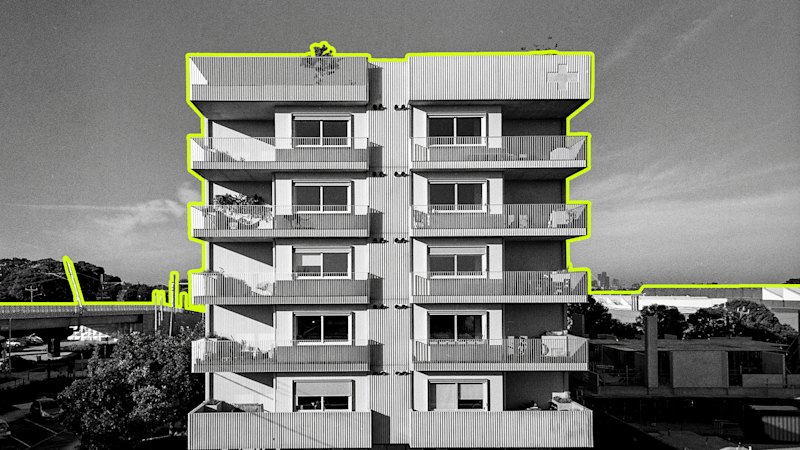
In one ideal of suburbia, there are no backyard fences.
They’ve been ripped out in favour of shared “in-between” space, filled with more trees, lush community gardens, playgrounds – and what Dogma Architects describes as a kind of “long house”.
“We imagine a dedicated structure … developing as a spine on the back of these houses,” said Pier Vittorio Aureli, co-founder of the Brussels-based architectural firm. “It’s really a hybrid of a space that is common but remains also quite domestic in scale.”
Domestic functions usually found in private homes are concentrated inside the long houses: kitchens, workspaces, study areas, libraries, and facilities to care for children and elderly people. And, when they are in a single, shared space, it allows for smaller, less cluttered homes around them.
Originally pitched in Flanders, Belgium, the model would be a “very simple but very powerful” option to reimagine suburbia, Aureli told the symposium.
“What makes [the suburbs] attractive to many people is that these are places where you can raise children more easily than in cities, but also places where you can age more decently than in cities,” Aureli said.
“But this often requires a lot of spaces for caring … which can be actually shared among different households.”
The space in between suburban homes could also be filled with modest unit blocks, on land leased by owners in exchange for tax breaks or other benefits, Aureli said. This model would create an off-road green path through the suburbs – in what the architect conceded is perhaps a “utopian scenario”.
“Of course, if land is leased, [it means] the cost of housing will be much less than housing built on market value land,” Aureli said.
“[It could] become a new form of mass housing built within the suburban block – but actually inside blocks, so it is also [not] completely [changing] the image of suburbia.
However unlikely that vision, it abides by the three tenets of designing suburbia, Aureli said: densification, co-operation and decommodification.
They’re principles reflected, too, in Adelaide University associate professor Damian Madigan’s “bluefield housing” model – once a hypothetical in Madigan’s PhD thesis, since written into state law in South Australia (an Australian first).
The model reconfigures existing large homes in older suburbs into three or more independent dwellings, anchored by a shared central garden. It deploys commonly accepted renovation methods (like adding extra rooms) to avoid pushback from neighbours and planning authorities – particularly in suburbs where heritage protection is used to oppose change.
Bluefield homes have to be converted from single ownership into strata or community titles, and the model ignores prior minimum lot sizes on the basis they don’t guarantee design success, Madigan said.
“We instinctively think of someone gaming the system as someone doing something wrong,” Madigan told the symposium. “But I think it’s something that’s very powerful if we can do it in the right way, and with the right intentions.”
After the symposium, students and architects spilled out of the lecture theatre, towing leather and canvas bags.
They congregated beneath the coffered ceiling of the Glyn Davis Building’s central atrium, standing beside steel mesh balustrades and with students also hunched over tables, sketching.
Delia Teschendorff began recruiting architects to speak at the symposium some months ago, along with her group of co-conveners (Alan Pert, Ash Alam and Rory Hyde). But they didn’t plan for them to share a common thread.
“What was really beautiful in the design session was the way ... [the speakers talked about] the need to create more shared communal space, and within that, of course, we can bring more ecology, and biodiversity and trees,” said Teschendorff, an architect and education fellow.
“The way that politicians are addressing the housing crisis and providing new homes ... in this very fast-track manner, the environmental impact is so great that we can’t continue in this way.
“We need to rethink the way that we’re doing these things, while still preserving some of those beautiful qualities of the suburbs that we love.”
The suburbs are Australia’s future cities, and the most crucial challenge of our built environment, Teschendorff said.
The co-conveners chose the speakers based on a particular criterion: they are beacons of innovation and hope.
Melbourne Assembly will be held from October 19 to 21. More information is available on the Melbourne Assembly website.
Citations · 2 reports from 2 outlets
Tap a citation to read it above, right here on T.A.M.
Nightingale is revered in Melbourne. Its creator says it won’t fix the housing crisis
In a lecture theatre inside one of Melbourne’s premier design schools, Jeremy McLeod took the podium – and rattled the room.
1 day ago · Cassandra MorganNightingale is revered in Melbourne. Its creator says it won’t fix the housing crisis
In a lecture theatre inside one of Melbourne’s premier design schools, Jeremy McLeod took the podium – and rattled the room.
1 day ago · Cassandra Morgan