
The Avalanches unravel the past: ‘If an ad is seared into my brain, is that of any less worth than a great piece of pop?’
The Avalanches dig into old jingles and outdated technology to bring us the future on their new album.
First reported 1 hour ago · latest update 1 hour ago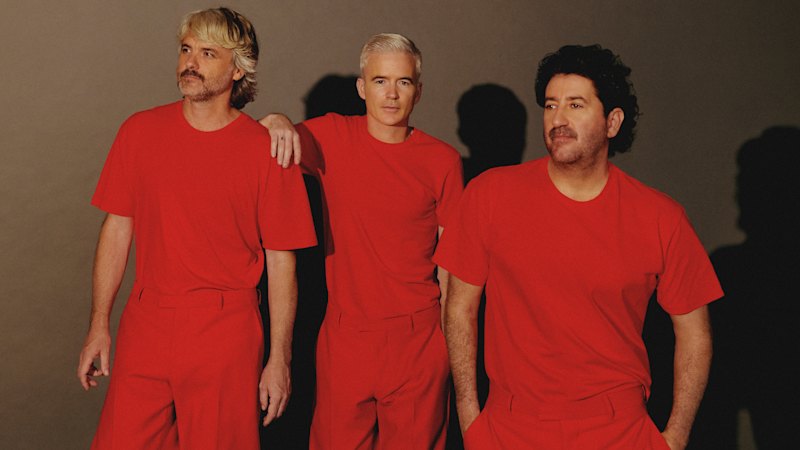
You have reached your maximum number of saved items.
Remove items from your saved list to add more.
You've used all of your gift articles. 3 more will become available on the 1st of every month.
Robbie Chater and Tony DiBlasi are not exactly sure what time zone their bodies are in right now. They’ve just done a whirlwind press tour that’s taken in Melbourne, Sydney, Milan, New York and Los Angeles, before returning to their adopted home town of London. Where in London exactly?
“Hackney, like every other musician in London,” says DiBlasi, with a self-deprecating grin. “It’s compulsory, like musicians having to live in St Kilda or Fitzroy in Melbourne back in the day.”
The two core members of The Avalanches (new third member Andy Szekeres, formerly of Midnight Juggernauts, wasn’t present) live about 50 metres apart, in separate apartments in the same building. They used to live even closer together when they were teenagers in the ’90s, just out of high school and sharing a dilapidated flat in Carlton.
“Parts of the ceiling in the lounge room actually fell through, so you would sit in there and see the sky and be open to the elements,” remembers DiBlasi.
“We shared a bedroom with two single mattresses on the floor and a bong and a stereo in between us,” adds Chater. “We had this one Beatles tape and I remember we used to play Across the Universe over and over again.”
The past has been on both their minds of late. Their new album No Bad Memories – its cover artwork depicts an anthropomorphised iPod and floppy disk – is based around the theme of a nostalgic yearning for the sounds and technologies of the recent past, whether that’s a 1980s breakfast cereal commercial jingle or the start-up sound of a 1990s computer hard drive.
“Working with samples all our lives, we’re always thinking about memory and the past life that music had,” says Chater. “And now we’re a bit older, I think we’re reflecting on our lives as consumers in this crazy capitalist society. And also the devices where we used to store our memories now have this poignancy, whether that’s the iPod, this personal library you held on a device before streaming and the cloud, or floppy disks, which are special to us because every sound on Since I Left You was stored on them.”
Since I Left You, their debut album, was a phenomenon. Released in 2000 and built entirely from samples – reportedly more than 3500 of them but even Chater and DiBlasi are unsure – it was groundbreaking in its construction as well as being a commercial and critical success, hailed as a masterpiece and pioneer in the genre that became known as “plunderphonics”. Technology may have advanced at an astounding rate since then but a quarter of a century later they still see similarities between how they approached music then and now.
“Obviously, some things are completely different,” says DiBlasi. “We no longer use floppy disks and we now have nice, light laptops instead of a computer that weighs 42 kilos or whatever.”
“Back then we were all on the dole, so we didn’t have much money,” says Chater. “We had a map of all the Melbourne train lines and would go along them one by one and do every op shop down each line, scouring them for old records. You could get 10 records for a dollar. People were throwing away gold.
“We found all this exotica stuff by Martin Denny and Arthur Lyman, and that kind of Hawaiian barbecue music from America in the ’50s and ’60s, and all these romantic orchestral records, and that became our sound palette.
“We still spend days and weeks going through albums, looking for that little three-second moment that’s magical. There’s no shortcut to the time spent digging and listening. That part is exactly the same as it was 25 years ago.”
Although their recording process has become more streamlined than it was back in the day – they no longer rely on second-hand 1990s-era samplers and mixers – some things have become more difficult, especially clearing samples.
“It takes a hell of a lot of time and it’s harder than it used to be because back then you were often just dealing with an individual,” says Chater. “What we’re finding now is that huge companies buy up entire old catalogues of music for the purpose of monetising them, so there are lawyer letters and more money involved. Some samples we just have to let go because it’s not worth it.”
Still, their powers of persuasion have worked wonders in the past – after all, they managed to get permission to sample big-ticket songs such as Madonna’s Holiday and The Beatles’ Come Together.
The new album features heavy hitters in the guest list, across a wide range of ages and genres, including Karen O of the Yeah Yeah Yeahs, Rivers Cuomo of Weezer, Panda Bear of Animal Collective, Tunisian footwork artist Khadija Al Hanafi, 79-year-old former Yellow Magic Orchestra co-founder Haruomi Hosono, and more.
New track Our Love Is Alive, which features Scottish DJ and producer Barry Can’t Swim, includes a sample of composer, sound designer and electronic music pioneer Suzanne Ciani from a 1980s TV show where she explained how synthesisers work.
“She’s been a hero of ours for years for her modular synth work,” says Chater of Ciani, who at 80 is touring Australia this year. “But it was amazing diving into her work with companies like Atari and Coca-Cola. That iconic advertising sound of a Coke bottle being opened was something she created on analog gear in the ’80s and they still use that sound today.”
The Avalanches went so far down the rabbit hole of yesteryear’s commercialism that they also dreamt up their own fictional products for the new album, along with jingles and sound tags to accompany them, including a soft drink called El Dorado and a game console called Superfun.
Chater found the research process instructive, “and it made me realise that if a cereal commercial from when I was six years old was so evocative that it’s still seared into my brain and transports me back to that time, is that of any less worth or any less genius than a great piece of pop songwriting?”
Also in the works is an accompanying 35-minute film starring Haley Joel Osment (The Sixth Sense) as a man who works for a Japanese company that helps people upload and archive all their memories contained in videotapes, cassettes, CDs and photo albums. In the end he has trouble distinguishing his own memories from all the media and advertising he’s consumed over the years and finally loses himself inside a giant iPod. So, not a happy ending?
“I think it could be seen as a happy ending,” says DiBlasi. “He disappears into this vortex of memory and advertising. So I guess it depends on your definition of happiness.”
The past has not always been such a happy place for Chater. The 16-year gap between Since I Left You and its follow-up Wildflower was due to a number of reasons, including perfectionism, intense pressure from high expectations and their record label collapsing – but Chater also suffered from two autoimmune diseases. And before that, years before The Avalanches’ debut album, he had already developed a severe alcohol problem from a young age.
“I got in deep trouble,” he says. “I found myself drinking daily and constantly. I built up this tolerance but, eventually, if I went two or three hours without a drink I would get the shakes and have to drink again.”
He tried to stop on his own but had a withdrawal seizure and ended up in intensive care. It might sound like a cliche to say music saved him but when the two old friends talk about what happened next, it’s difficult not to think of it that way.
“I remember getting a call from Robbie from rehab and he asked me to bring his sampler down the next time I visited,” remembers DiBlasi. “So I took it to him, and the next week when I visited again he played me the beginnings of Radio [which eventually became the third track on Since I Left You] and things just blossomed from there.
“I always think of that lyric ‘since I left you/I’ve found a world so new’ as Robbie leaving alcohol behind and us discovering this whole new world of music together. It’s a real expression of joy.”
Chater nods in agreement. “I was so lost and afraid before,” he says. “But after I got through it I was just so happy and full of life to be free of this nightmare. Then song after song just kept flowing out. There was this incredible outpouring of creativity. I didn’t even want to sleep.”
The Avalanches’ new album No Bad Memories is out now. Their national tour takes in Perth Festival on February 27 and 28, Adelaide’s Hindley St Music Hall on March 4, Melbourne’s Royal Botanic Gardens on March 5, Brisbane’s On the Banks on March 6, and the Sydney Opera House Forecourt on March 7.
Citations · 2 reports from 2 outlets
Tap a citation to read it above, right here on T.A.M.
The Avalanches unravel the past: ‘If an ad is seared into my brain, is that of any less worth than a great piece of pop?’
The Avalanches dig into old jingles and outdated technology to bring us the future on their new album.
1 hour ago · Barry DivolaThe Avalanches unravel the past: ‘If an ad is seared into my brain, is that of any less worth than a great piece of pop?’
The Avalanches dig into old jingles and outdated technology to bring us the future on their new album.
1 hour ago · Barry Divola