
Satellite images reveal damage to Saudi oil pipeline following drone attack
Satellite imagery has confirmed significant damage to a major Saudi Arabian oil pipeline following a drone attack. The incident led to the temporary closure of the 750-mile pipeline, which serves as a critical alternative route to the Strait of Hormuz.
First reported 22 hours ago · latest update 22 hours ago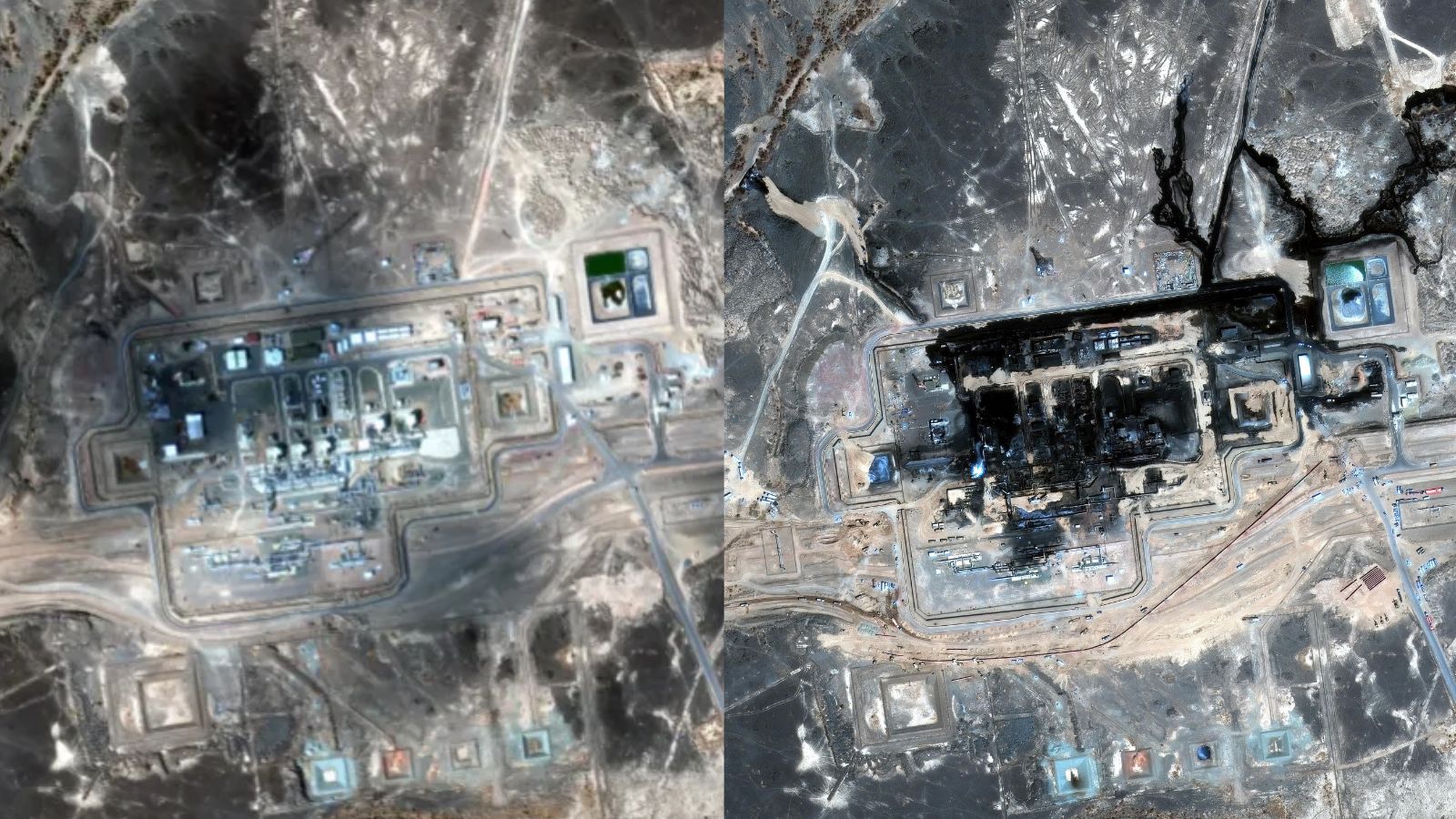
Newly released satellite photographs have revealed the extent of damage caused by a drone strike on Saudi Arabia's East-West pipeline, a vital artery that carries crude across the Arabian Peninsula to the Red Sea. Oil traders now warn that Saudi Arabia risks running out of exportable stocks within days unless the line is brought back into service, a shortfall that could remove close to 4% of global oil supply from the market.
The pipeline, which runs 1,200km (745 miles) from the Gulf coast to the port of Yanbu on the Red Sea, has for months allowed Saudi Arabia to sidestep the worst effects of the wartime closure of the Strait of Hormuz. Riyadh has not yet given a full account of the damage or said when the route might reopen, and estimates gathered by Reuters from industry sources range from a partial restart within days to repairs stretching out to six weeks.
What happened on 10 September Saudi officials said the pipeline came under attack on the morning of Thursday 10 September in the Riyadh and Medina regions, according to the Saudi Press Agency, cited by fact-checking outlet Misbar. The Ministry of Energy said the strikes caused injuries among workers, who received medical treatment, and that emergency crews moved in straight away to secure the site and assess the damage.
Saudi Arabia's Foreign Ministry said the drones had been launched from Iraq. . Energy · Explainer Saudi oil lifeline hit Drones from Iraq struck the East–West pipeline on the night of September 10–11. Riyadh shut it on Friday. With the Strait of Hormuz already choked, the kingdom has lost the workaround it had been leaning on.
Satellite evidence The site, before and after Before After PlayPause Before25%50%75%After Pause freezes the wipe where it is. Tap a stop to jump to a fixed position. Before Vantor satellite image shows the East–West pipeline pumping station in Saudi Arabia before the September 11, 2026 drone attack and resulting fires.
After This satellite image provided by Vantor on Sunday, Sept. 13, 2026 shows the aftermath of the recent drone attack on the East–West pipeline in Saudi Arabia. Satellite image ©2026 Vantor via AP Live story Market figures below are from trading on Monday, September 14, and will move.
Damage assessments, repair timelines and export volumes are all still provisional. ~4% Of global oil supply at risk Roughly 4 million barrels a day were moving through the line before the shutdown 1,200 km Eastern Province to Yanbu Capacity about 7 million barrels a day at full stretch 5–7 days Of export stocks left at Yanbu Reuters, citing unnamed industry sources — not an official Saudi figure $108 Brent touched, before easing Trading near $107.5, up roughly 3% on Monday morning The line Built to go around Hormuz EASTERN PROVINCEPersian Gulf YANBURed Sea East–West pipeline · Petroline · 1,200 km The whole point of the line is that oil reaches the sea without passing through the Strait of Hormuz.
With Hormuz constrained by Iran, Saudi Arabia had shifted several million barrels a day onto it. How it unfolded Thursday night, Sept 10–11 Drones hit the line Multiple drones struck pipeline infrastructure in the Riyadh and Medina regions, starting a fire and causing injuries. Equipment used to operate the line was among what was hit.
Friday, Sept 11 Riyadh shuts the pipeline The Energy Ministry said late on Friday that operations had been suspended as a precaution. It gave no detail on the extent of the damage, or when pumping might resume. How long to fix Estimates diverge sharply. One source cited by Reuters put repairs at five to six weeks; another expected a partial restart sooner.
Nobody has published an official timeline. Saturday to Sunday Iraq accepts the launch point Saudi Arabia said the drones came from Iraq. Baghdad’s investigation agreed, and the prime minister’s office said on Sunday that the commander of operations in Maysan province had been dismissed.
Saudi Arabia said it would not retaliate, at the Iraqi prime minister’s request, while reserving the right to act. Who did it No group has claimed the attack. President Trump said over the weekend that he holds Iran responsible. Tehran denies involvement. Attribution remains contested.
Monday, Sept 14 Brent touches $108 Crude jumped as markets opened for the week, Brent reaching $108 a barrel before easing back to around $107.5, up roughly 3%. Asian refiners were still waiting on Saudi guidance about cargoes due at Yanbu. The wider squeeze Two sea gates and a pipeline, all under pressure Constrained Strait of Hormuz Effectively closed to much traffic by Iran during the war, which is what pushed Saudi crude onto the pipeline in the first place.
Analysts note sizeable volumes are still moving through it. Shut East–West pipeline The overland bypass, now offline after the drone strike. Yanbu can keep loading only while stocks at the port last. Contested Bab el-Mandeb The gate any cargo leaving Yanbu southbound must pass. Houthi forces took Perim island in the strait on Friday and have declared a blockade on Saudi-linked shipping.
This is a separate conflict from the pipeline attack. Two maritime chokepoints disrupted.One pipeline under pressure. Do not conflate the two The pipeline was struck by drones launched from Iraq, and no group has claimed it. The Houthi advance on the Red Sea coast is a separate campaign.
Both squeeze the same Saudi export route, but they are not the same actor or the same event. A date that varies by source Accounts differ on when the drones hit. Saudi Arabia’s Energy Ministry described attacks on Thursday, September 10, with the shutdown announced late on Friday; AP’s satellite caption dates the attack to September 11.
The strikes appear to have run through Thursday night into Friday. What is not yet known Saudi Arabia has not said how badly the line is damaged or when it will restart. Casualty detail extends to injuries only, with no official toll published. Export and stock figures come from traders and industry sources rather than from Aramco.
A live, fast-moving story. Oil prices, repair estimates and export volumes are provisional and were accurate at the time of compilation on Monday, September 14, 2026. Sources: Reuters; The National; Bloomberg; Al Jazeera; AFP; US Energy Information Administration. Express InfoGenIE · Global Desk .
BBC reported that Riyadh shut the pipeline down as a precaution once the scale of the damage became clear, with images of scorched earth and rising smoke soon circulating. Satellite evidence of the fire Analysis by Misbar's editorial team, working with imagery from the Copernicus Browser platform, tracked the aftermath through data from the Sentinel-2 and Sentinel-3 satellites.
A large, elongated dark plume consistent with smoke appeared in imagery captured on 10 September, absent from a clear image taken the day before. By 11 and 12 September, the plume had dispersed, but wider-angle pictures from 12 September showed a blackened, charred area around the pumping station that was not present in equivalent imagery from 7 September.
This satellite image provided by Vantor on Sunday, Sept. 13, 2026 shows the aftermath of the recent drone attack on the East-West pipeline in Saudi Arabia. (Satellite image ©2026 Vantor via AP) Meanwhile satellite operator Vantor released images comparing the site before and after the attack, showing a pumping station that the Guardian described as visibly charred and damaged.
The BBC published similar before-and-after imagery supplied by Planet Labs PBC. Iraq's response and a denial from militia groups Iraq's government said it had removed a military commander from his post and opened an investigation after confirming the drones had been launched from Maysan governorate, a province bordering Iran, the BBC reported.
Baghdad said in a statement that it condemned the attack and would not tolerate any activity that endangered its ties with neighbouring states. However, armed factions linked to the Islamic Resistance in Iraq denied any involvement, saying in a statement reported by Misbar that they were surprised the Iraqi government had moved so quickly to accept the allegations without what they called credible evidence.
The East-West pipeline. (File Photo: US Energy Information Administration) Saudi Arabia has so far held back from retaliating, its Foreign Ministry said, after a phone call with Iraq's prime minister, though it added that it reserved the right to take whatever measures were needed to protect its territory and facilities.
The Gulf Co-operation Council issued its own statement condemning the strike as a dangerous escalation. With the pipeline offline, the Reuters sources said Yanbu had enough stock to maintain exports for only five to seven more days. Saudi Arabia also holds reserves at Egypt's Ain Sukhna terminal on the Red Sea and Sidi Kerir on the Mediterranean, though a fourth source told Reuters those, too, were not full and would eventually run dry without the pipeline back in operation.
Oil prices climb as diplomacy stalls Brent crude rose more than 3% to around $108 a barrel on Sunday, its highest level since May, as the market weighed the loss of Saudi supply on top of existing disruption from the Strait of Hormuz. The BBC quoted Richard Bronze of Energy Aspects, who said the market's usual buffers had largely been exhausted, meaning prices were likely to keep climbing if the crises in the region persisted.
He added that prices could return to the $120 peak seen earlier in the Iran war, or go higher still, unless conditions across the Middle East improve. The East-West pipeline carries crude from Saudi Arabia’s eastern oil-producing region to the Red Sea port of Yanbu, allowing exports to bypass the Strait of Hormuz. (Photo: Al-generated) Hopes of easing tension were dealt a setback when Oman's foreign minister, Sayyid Badr Albusaidi, announced that a regional meeting planned for Monday had been postponed "in the interests of consensus," according to the Guardian.
Iranian officials had been expected to attend and present a proposed agreement with Oman on governing shipping through the Strait of Hormuz, which Iran now requires vessels to seek permission to use. Houthi advance adds pressure in the Red Sea The disruption to the pipeline has coincided with rapid gains by Yemen's Iran-aligned Houthi movement, which the BBC and the Guardian both reported has seized much of the country's Red Sea coastline, including the strategic city of Mokha and the island of Perim in the Bab al-Mandab Strait.
The Houthis said shipping through the strait remained open to all vessels except those belonging to Saudi Arabia. Government-aligned Yemeni forces said they had struck back around Mokha, destroying vehicles and weapons and killing a number of Houthi fighters, according to military spokesman Majid al-Nuzaili.
The United Nations said at least 76,000 people had been displaced in Yemen since July, with the pace of displacement quadrupling over the past week, warning of families fleeing at night with nothing but the clothes they were wearing. The combined pressure on Gulf and Red Sea shipping routes has pushed diesel prices in the United States past $6 a gallon, a record high reported by the Guardian, with knock-on effects expected for manufacturing and transport costs more broadly.
Energy Aspects' Bronze noted that rerouting Saudi oil via the Suez Canal and around Africa was already adding around 30 days to shipping times even before the latest escalation, pushing up both transport costs and inflation fears worldwide. Also read Houthis close in on Bab el-Mandeb as Saudi Arabia strikes back: 10 updates The crisis in the Middle East is now in its seventh month, following the US and Israeli strikes on Iran launched on 28 February.
Citations · 2 reports from 2 outlets
Tap a citation to read it above, right here on T.A.M.
Before and after: Satellite images show severe damage to Saudi oil pipeline after drone attack
22 hours agoSatellite images show extent of damage to Saudi Arabia’s oil pipeline that bypasses Strait of Hormuz
Saudi Arabia temporarily shut the roughly 750-mile pipeline as attacks threaten a key alternative to the Strait of Hormuz.
22 hours ago