
Astrophysics study suggests Venus may have once possessed a moon
New research using computer simulations suggests that Venus may have previously had a moon that eventually crashed into the planet. Scientists propose that the planet's exceptionally slow rotation speed made the orbit of a natural satellite unsustainable.
First reported 2 days ago · latest update 18 hours ago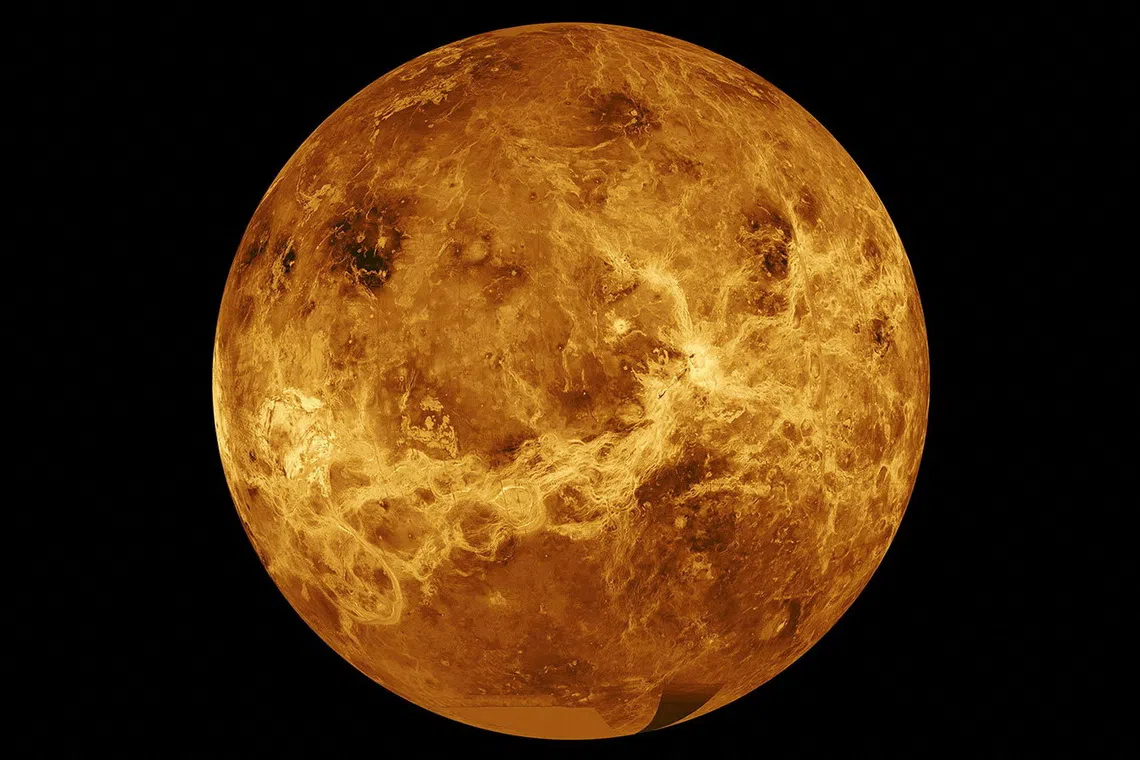
A new study published in The Astrophysical Journal proposes that Venus may have once possessed a moon that was eventually consumed by the planet. While previous scientific theories suggested that Venus either never formed a moon or lost one due to a massive external impact, this research suggests the planet’s own physical characteristics were responsible for the satellite's disappearance.
The study, led by astrophysicist Stephen Kane of the University of California, Riverside, utilizes computer models to simulate the gravitational mechanics of hypothetical moons orbiting Venus. The findings indicate that the planet's extremely slow rotation on its axis would have prevented it from maintaining a stable satellite. Unlike Earth, which rotates rapidly enough to transfer energy to its moon and push it further away, Venus lacks the rotational speed necessary to sustain a lunar orbit.
According to the research, any moon orbiting Venus would have been pulled gradually closer to the planet due to gravitational forces. Over time, this orbital decay would have resulted in the moon spiraling inward and ultimately crashing into the planet’s surface. The study suggests this cataclysmic event likely occurred within the first billion years of the solar system’s 4.5-billion-year history.
This explanation marks a departure from traditional hypotheses regarding the absence of a Venusian moon. While earlier models relied on the necessity of a dramatic, external collision to explain the current state of the planet, this research posits that the collapse was a natural consequence of planetary physics. By modeling various moon sizes, the researchers concluded that all hypothetical satellites would have met the same fate, eventually being absorbed by the planet.
The mechanics of this process are contrasted with the current behavior of Earth's moon, which is measured to be drifting away from our planet at a rate of approximately four centimeters per year. This outward movement is supported by the energy transferred from Earth's 24-hour rotation. Because Venus rotates much more slowly, it is unable to exert the same influence, rendering it incapable of keeping a moon in a stable, long-term orbit.
Citations · 3 reports from 3 outlets
Tap a citation to read it above, right here on T.A.M.
Astrophysics study suggests Venus may have swallowed its moon - Reuters
Astrophysics study suggests Venus may have swallowed its moon Reuters
2 days agoAstrophysics study suggests Venus may have swallowed its moon
The slow speed at which Venus rotates dooms any orbiting natural satellite to crash into it.
1 day agoVenus may have swallowed its own moon
Venus may have once had a moon, but new research suggests the planet’s incredibly slow rotation could have doomed it. Computer simulations showed that instead of gradually drifting away like Earth’s moon, a Venusian moon would likely spiral inward until it crashed into the planet, with larger moons falling even faster.
18 hours ago