
Political commentary on Australian government strategy and opposition leadership
Commentary suggests that the federal government's incremental policy approach is facing challenges. The piece also characterizes the current state of the Liberal Party's leadership.
First reported 1 hour ago · latest update 1 hour ago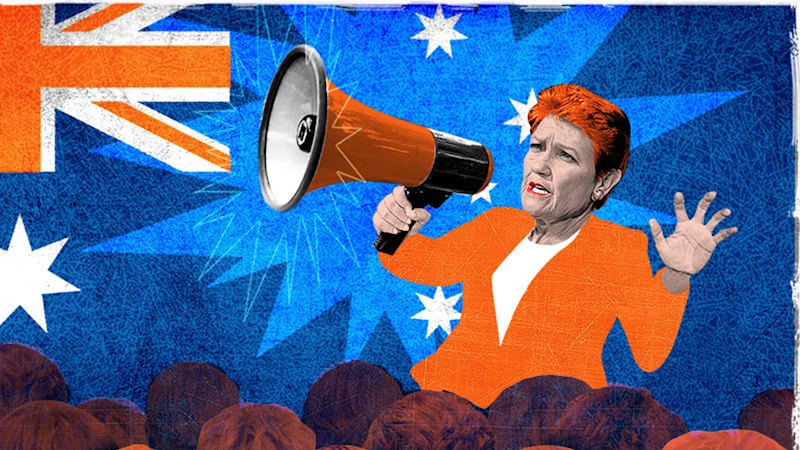
You have reached your maximum number of saved items.
Remove items from your saved list to add more.
Things are going swimmingly for Pauline Hanson’s One Nation party, that’s for sure. The emerging narrative is that Hanson leads an unstoppable national movement. The latest Resolve Political Monitor suggests that One Nation is a mere point behind the Labor Party on the primary vote nationally, with the Coalition parties in third place, and is actually leading Labor and the Coalition in NSW and Queensland.
Further bolstering One Nation’s chances are the declining fortunes of the Labor and Liberal parties under their current leaders. Anthony Albanese’s hare-and-the-tortoise political strategy, built on policy incrementalism, was fashioned when he took over as leader in 2019 and the country and the world were very different. The tortoise is now on life support. His opposite number Angus Taylor is a store-bought Liberal leader who looks the part but will eventually have to make way for Andrew Hastie.
So as One Nation marches on and prospers, it warrants an audit, because if public opinion keeps trending the way it’s been going over the past year, the next election, no more than 20 months away, will be the most momentous national event since Federation.
One Nation is unlike any mainstream party Australia has ever seen. You would need an advanced degree in Kremlinology to fully understand its inner workings and who’s in and who’s out, but it is essentially an expression of Hanson’s personal views. These angry views are not so much of the world – she rarely opines about complex international matters apart from her full-throated and unswerving support for Donald Trump – but of Australia and how it’s stuffed. She is always in high dudgeon. Her faithful retainer James Ashby is the political brains of the outfit and Barnaby Joyce plays the experienced media-facing “safe pair of hands” role to varying degrees of effectiveness.
Hanson’s media appearances are tightly controlled. She’s already started kicking out reporters from The Guardian and the ABC from press conferences because those outlets displease her. However, when she is questioned, she can be relied on to share her prejudices, none of which have changed in the 30 years since she first arrived as a political candidate warning that the country had already gone to hell.
These are just some of the views she has expressed: Indigenous Australians are the most primitive people on Earth, who have achieved nothing; workers are lazy, and don’t deserve pay rises or increased bargaining capabilities or protections such as paid parental leave and should be easier to sack; people in public housing should move on after a couple of years; not one of the 800,000-plus people of the Muslim faith in Australia are any good; child care looks like a scam; Australia must go back to the way it was 50-odd years ago, with “one culture”; SBS should be shut down and the ABC killed as the national broadcaster, moving to a subscription model in metropolitan areas.
On Monday, she released the party’s immigration policy via social media. There was no press conference on a policy that is the closest thing to One Nation’s core business. Instead, she was later interviewed on her preferred outlet News 24 (formerly Sky) in which she said several times, “I’m implementing the will of the people.”
That form of words echoed populist leaders of the extreme right and left going back to the early years of the 20th century. The paradox of the internet and what in the 1990s was referred to as the information revolution is that despite the availability of foreign news, it has encouraged solipsism and distraction. That has in turn led to insularity within nations; most of us believe our economic and social problems are unique to where we live, when they’re not.
Here, for example, is former UK Conservative party leader and foreign secretary William Hague, writing in UK’s The Times last week, on Britain’s current plight: “We now face ageing populations, housing scarcity, energy insecurity, technological competition with the US and China, Russian aggression, weak productivity, strained public services and increasingly expensive welfare states.” Does that not sound like Australia too?
The shrinking of the world via digital communications has been a boon to right-wing nativist populist movements, helping them to work together, instantaneously sharing information, rhetoric, messaging techniques and vote-harvesting practices. Joyce recently outlined One Nation’s place in this populist constellation, rejecting any similarity with the crypto-fascist AfD in Germany, which he derided. “It’s not like [prime minister] Giorgia Meloni in Italy, which is fine. Even [the leader of the French National Rally party, Marine] Le Pen, may be a bit on the edge, but fine. [Leader of Reform UK, Nigel] Farage, he’s got his other problems, but fine. The MAGA movement, fine.”
Meloni and Le Pen’s parties are modern versions of organisations that held sympathetic opinions about past fascist movements in their respective countries. As for MAGA being “fine”, that was not the “will of the people” in Australia in May last year when Trump’s application of tariffs on all but a handful of countries, including Russia, helped Labor win a record parliamentary majority.
These two facts co-exist: One Nation is popular and it is radical – highly radical. The move to One Nation is real, as demonstrated in byelections in NSW and Western Australia, and at the South Australian election. The question is how much a truly radical alternative becomes normalised in the national discussion when it can count on close to one in three voters.
Until the federal election, we can all be experts. Some say that Hanson’s electoral support is fireproof, that no matter what she says, people will stick with her. In that analysis, they’ll come for the thrill of giving the two big established parties a bollocking and stay for the divisiveness, viciousness and widespread social disruption.
What will help that come to pass is if sustained, legitimate scrutiny of One Nation all gets too hard for the media and business and other elements in civil society because it’s popular and who wants to go against the vibe? No question, the big parties have been letting most Australians down for most of this century. But seeing One Nation as the solution is a case of careful what you wish for.
Shaun Carney is a regular columnist, an author and former associate editor of The Age.
The Opinion newsletter is a weekly wrap of views that will challenge, champion and inform your own. Sign up here.
Citations · 2 reports from 2 outlets
Tap a citation to read it above, right here on T.A.M.
The radical is becoming normal under Hanson. If you’re not worried, you should be
Anthony Albanese’s hare-and-the-tortoise political strategy, built on policy incrementalism, is now on life support. Angus Taylor is a store-bought Liberal leader who looks the part but will eventually have to make way for Andrew Hastie.
1 hour ago · Shaun CarneyThe radical is becoming normal under Hanson. If you’re not worried, you should be
Anthony Albanese’s hare-and-the-tortoise political strategy, built on policy incrementalism, is now on life support. Angus Taylor is a store-bought Liberal leader who looks the part but will eventually have to make way for Andrew Hastie.
1 hour ago · Shaun Carney