
Month after deadly avalanche, Nepal braces for heavy rain, floods again
Some areas of the two provinces could also receive extremely heavy rainfall during the September 25 to 27 period, according to the department's Weather Forecasting Division.
First reported 3 days ago · latest update 1 hour ago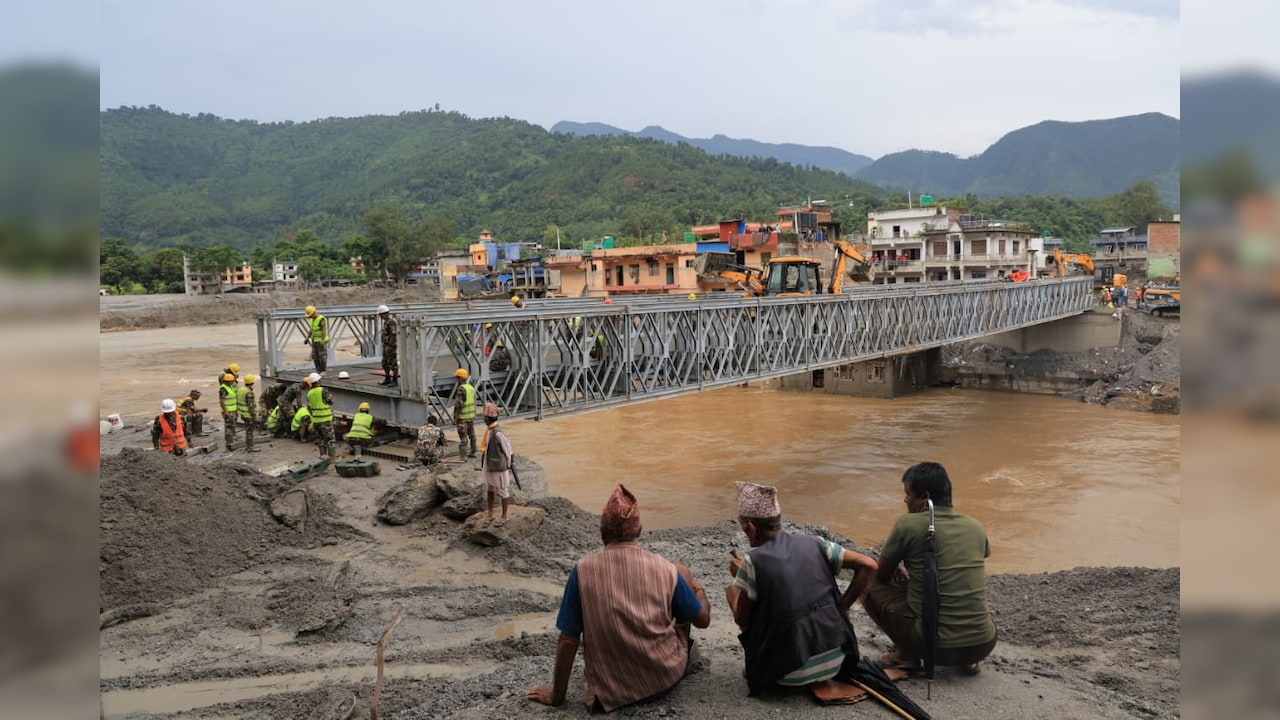
A month after devastating flash floods ripped through Nepal, leaving over 1,400 people dead and several others missing, the country stands at risk of another deluge, The Kathmandu Post reported. A low-pressure system over the Bay of Bengal has been triggering rains in Nepal, with forecasts of heavy to very heavy rains in parts of Koshi, Bagmati, Gandaki, Lumbini and Karnali, the country's weather department said.
What are the risks? The effects of the weather system, which moved over Chhattisgarh, were gradually spreading across Nepal, meteorologist Rojan Lamichhane said. The flood forecasting division warned of moderate to high flood risk for several small rivers. As many as 12 districts - Gorkha, Lamjung, Kaski, Manang, Mustang, Dang, Banke, Bardiya, Surkhet, Dailekh, Kailali and Kanchanpur - are at high risk of flooding.
According to the Department of Hydrology and Meteorology, Nepal, one or two places in Lumbini and Gandaki could receive extremely heavy rain, while heavy rain is also expected in parts of Madhesh. Thunderstorms and strong winds may also hit certain regions of Madhesh, Koshi, Bagmati, Gandaki and Lumbini provinces.
With Karnali and Sudurpaschim also likely to bear the brunt of the weather system, Lamichhane urged people there to suspend activities such as rice harvesting for the next few days. In the past 24 hours, heavy rain was recorded at several locations in Koshi, Bagmati, Gandaki and Lumbini provinces.
Palpa recorded more than 187 mm of rain, while certain locations in Lumbini, Gandaki and Bagmati got up to 100 mm. The mountain districts also reported moderate to heavy snowfall. What is happening in Odisha and Chhattisgarh According to the India Meteorological Department (IMD), a deep depression from the Bay of Bengal was centred over southern Chhattisgarh and adjoining southern interior Odisha at 8.30 am on Friday.
It was located near Odisha's Nuapada, about 80 kilometres east-southeast of Chhattisgarh's Raipur, 130 kilometres south-southwest of Champa and 140 kilometres south of Bilaspur. It then moved north-northwest at a speed of 15 kilometres per hour and was expected to remain at depression strength for the next 12 hours.
In the following 12 hours, it is expected to weaken to a well-marked low-pressure area, the department said. Call for Nepal, India, China cooperation to tackle climate risks at Himalayas Speaking at the United Nations General Assembly on Friday, Prime Minister Balendra Shah warned that the deadly Bhotekoshi-Trishuli floods were a glimpse of the aggravating climate risks facing the Himalayas and called for cross-border cooperation to tackle it. “The Bhotekoshi-Trishuli disaster was not just a local tragedy; it was a warning to the world.
And I ask you today: have we really heard that warning?” The Kathmandu Post quoted him as saying at the 81st session of the UN General Assembly. “I come before you from Nepal, a distant country in the Himalayas, carrying a close warning for humanity,” he said, mentioning that the floods were likened to a "Himalayan Tsunami".
Express Opinion | Nepal’s climate call is a test for India “A warming climate is destabilising the fragile Himalayan ecology,” The Kathmandu Post quoted Shah as saying. He pointed out that even as Nepal contributes less than 0.1 per cent of global greenhouse-gas emissions, its glaciers are melting, mountain slopes are becoming unstable and rivers increasingly unpredictable.
He underscored the need for cross-border cooperation to tackle such risks as he spoke about the devastation spreading across the Nepal-China border, with the waters flowing even into India. “Climate change does not recognise borders,” Shah said. “Glaciers and floods do not travel with a visa stamped on passports.” He proposed a Himalayan Climate Resilience Mechanism, led by Nepal, India and China, to boost the region’s ability to forecast and respond to climate-related disasters.
The mechanism would help in sharing satellite data and expertise, monitoring risky glacial lakes, strengthening joint early-warning systems and coordinating cross-border response to disasters. Shah said that the Himalayas should become a “laboratory of international cooperation” instead of a region where critical information remains fragmented.
Citations · 3 reports from 3 outlets
Tap a citation to read it above, right here on T.A.M.
Month after deadly avalanche, Nepal braces for heavy rain, floods again
1 hour agoHeavy Rain Alert In Nepal Month After Devastating Flash Floods
Some areas of the two provinces could also receive extremely heavy rainfall during the September 25 to 27 period, according to the department's Weather Forecasting Division.
3 days agoNepal faces fresh heavy rain, mudslide threats a month after devastating floods
Nepal faces fresh heavy rain mudslide threats a month after devastating floods
15 hours ago