
Crime is the punishment for a premier stuck in a law-and-order arms race
As Chris Minns talks tough on crime, his rivals try to talk tougher. It’s becoming an election focus he didn’t want.
First reported 1 hour ago · latest update 1 hour ago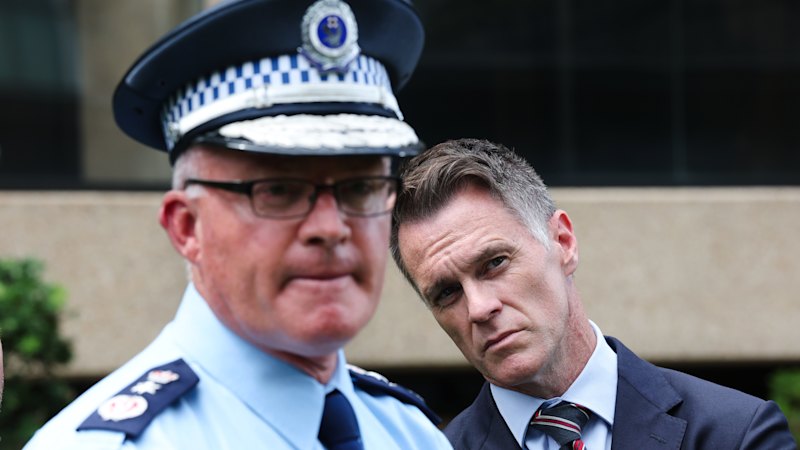
You have reached your maximum number of saved items.
Remove items from your saved list to add more.
At a press conference in the level-nine garden at NSW parliament last week, Attorney-General Michael Daley was forced to pause as he shuffled through a thick stack of papers searching for an answer in one of the many, many crime bills his government is currently pushing through.
Who can blame him? The spate of Sydney shootings linked to organised crime has prompted a rush of legislation from Labor.
There have been two tranches in the current sitting, including laws under which kids who are recruited by organised crime to carry out gang shootings and firebombings will face adult sentences, powers allowing police to force people to hand over digital devices they suspect are associated with organised crime, and expanded Serious Crime Prevention Orders allowing police to immediately restrict a high-risk suspect’s movements via an interim court order.
That is by no means an exhaustive list of the changes currently before parliament, nor are they the only changes the government has made. There have been laws making it harder for children to receive bail for break and enter offences, permanent knife “wanding” powers that allow officers to use handheld electronic metal-detecting scanners to conduct random searches at train stations, and even laws empowering police to monitor people in the far-west town of Moree via aerial drones.
Over the past 3½ years, the Minns government has made it a top-line priority to be seen as tough on crime. The similarities between Minns’ operation and the previous state Labor governments of Bob Carr and Morris Iemma have been oft-noted. The law-and-order agenda is straight from their playbook. Basically, the logic goes, in a conservative media ecosystem such as NSW, a centrist party like Labor has to neutralise crime as an issue to govern.
And yet, the latest outbreak of shootings – coupled with the horrific spate of alleged domestic and family violence crimes over the weekend – shows that despite Labor’s best efforts, crime isn’t going away. At the Liberal Party’s state conference on the weekend, Opposition Leader Kellie Sloane sought to put it front and centre. As my colleague Max Maddison wrote, Sloane spent two-thirds of her 18-minute speech talking tough on crime, compared with about three minutes on the economy.
With NSW Police Commissioner Mal Lanyon away on leave for the past two weeks, Minns has largely been left to carry the can on his own.
In some ways, all Labor has done is start an arms race, as both major parties (and now One Nation) try to appear as the toughest cop on the beat. While the government’s current bill makes it easier for police to seize people’s phones, for instance, the Coalition is moving amendments to expand the definition of what counts as a “dedicated encrypted criminal communication device”. The Coalition has also promised more “adult crime, adult time” laws, and to double the Crime Commission’s funding.
One Nation’s NSW leader, Mike Newman, says he would allow police to turn off their body-worn cameras so they can punch people who “take on the cops and punch them or do stupid stuff”. (Police union leader Kevin Morton labelled that “foolish”. It was police, after all, who campaigned for the introduction of body-worn cameras to head off vexatious complaints against them.)
Less central to the conversation has been the effectiveness of such reforms. All of these proposals have been floated as a response to media and public concern about a specific type of crime. A law that changed youth bail, called 22c, for example, was passed in response to an outbreak of break-and-enter and car offences in parts of western NSW. Now magistrates can only grant bail to a child aged 14 to 17 charged with motor theft or serious break and enter if they have a high degree of confidence they will not re-offend.
When Daley announced that Labor would expand the law beyond an existing sunset clause last week, he said a statutory review had found youth crime rates were falling, and fewer kids were committing those crimes, because of 22c. What the report actually found (as it emerged when it was released a couple of hours after the presser) was that while 22c had “likely” contributed to a disruption in short-term offending, the rate of offences had already peaked before it was introduced. In other words, while it might have helped, in the natural peaks and troughs of certain types of crime it was hard to say how much.
At the same time, youth justice advocates continue to warn that introducing more children to the criminal justice system will have far more negative long-term effects.
Minns was asked this week, in relation to the government’s harsher laws against domestic violence, whether he had reached the limits of what a tough-on-crime approach could achieve. He pointed out that he could not prove the counter-factual.
“I can’t go through the number of lives that have been saved because a vicious woman abuser has been kept in remand rather than being released on parole, how many crimes didn’t occur because someone was in prison and not on the streets,” Minns said.
Staring down the barrel of a law-and-order election next March, which the premier had worked so hard to avoid, Minns can only hope voters agree.
Michael McGowan is state political editor.
Get a weekly wrap of views that will challenge, champion and inform your own. Sign up for our Opinion newsletter.
Citations · 2 reports from 2 outlets
Tap a citation to read it above, right here on T.A.M.
Crime is the punishment for a premier stuck in a law-and-order arms race
As Chris Minns talks tough on crime, his rivals try to talk tougher. It’s becoming an election focus he didn’t want.
1 hour ago · Michael McGowanCrime is the punishment for a premier stuck in a law-and-order arms race
As Chris Minns talks tough on crime, his rivals try to talk tougher. It’s becoming an election focus he didn’t want.
1 hour ago · Michael McGowan