
Community impact of Australian Rules Football
As the AFL finals approach, local programs at JJ Holland Park are being highlighted for their role in supporting individuals who are marginalized, demonstrating the sport's social impact beyond professional competition.
First reported 45 minutes ago · latest update 45 minutes ago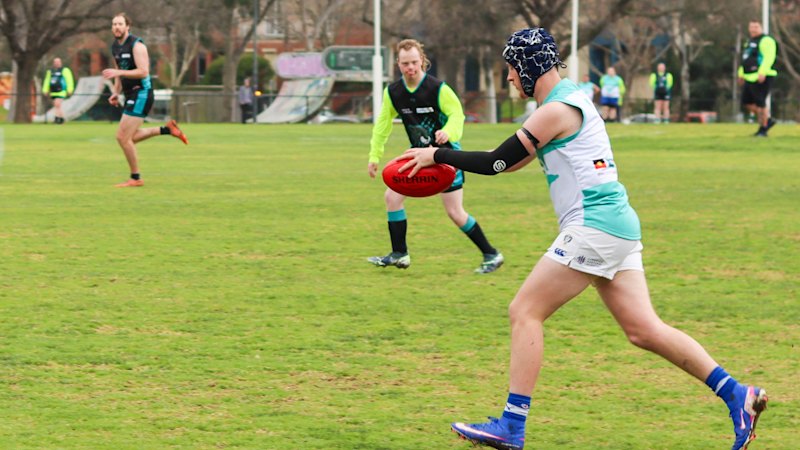
It’s a Wednesday afternoon during footy season at JJ Holland Park in Kensington, inner-city Melbourne, and there’s a game on.
Teams are warming up. A small group of fans line the boundary. Alongside the usual sausage sizzle and coffee cart that you might see, and smell, at any local footy match, there are a few marquees you wouldn’t typically walk past.
Liver health checks, employment services, and healthcare providers are set up around the ground. A small A-frame sign near the sheds is the only tell: “Welcome to the Homeless Cup”.
This isn’t your typical game of Aussie rules. It’s a CoHealth Kangaroos – or Kangas to the locals – home game. The Kangas are an Aussie rules team that plays in the Reclink Victorian Football League, a competition of 14 teams from all around Victoria, designed for people who don’t fit into mainstream footy clubs.
Whether it’s people experiencing homelessness, or at risk of homelessness, as well as those with physical or intellectual disabilities, finding a club to play for can be difficult. The Kangas program, like all Reclink teams, is open to anyone, no matter their ability, identity or living situation.
The rules of the comp are simple. Games are played fortnightly on Wednesday afternoons, with training on the off weeks. There is no pressure to attend, whoever turns up on the day gets to pull on a jersey and have a kick – no matter if it’s your first game, or you’ve been coming for years.
To make sure the league is inclusive of players with disabilities, players who wear a bright yellow vest are awarded marks for any contact with the ball, and cannot be tackled.
The players in the Kangas come from all across Melbourne. Some have been with the team for decades, like Gary, or Gaz, who is in 50s, and has been playing for the Kangas since its foundation. The years spent playing for the team, and the same players sticking around is a testament to the strong community and social connections the 26-year-old club has been able to build.
The Kangas program gives its participants routine and social connection, but it can also provide so much more. The laid-back, fun environment that footy provides allows caseworkers to build rapport with clients, who often come in guarded, and can be reluctant to extend trust and seek help.
Once they have built a relationship through the Kangas, staff can introduce the idea of linking participants with drug and alcohol support, gambling support, or healthcare providers, bridging the gap between these potentially life-saving services and the people who desperately need them.
Kangas’ scorekeeper, Raymond, has been homeless on-and-off since he was 18. He first learnt of the program through a community cricket competition, also run by Reclink, as he was sleeping rough at the ground at the time. Raymond, who struggles with gambling and alcohol addiction, says it gives him something to look forward to every week, and has contributed positively to his mental health.
“It’s a chilled-out environment”, says Andrew Bottriell, who coaches the Kangas as part of his homeless and community support worker role at CoHealth, a not-for-profit community health organisation based in Melbourne.
“We’re just out here doing footy, and having a couple of chats on the side. It’s very casual, and I think it definitely makes it easier to introduce the idea of, ‘Hey, do you need support?’”
And the services that the Kangas can connect participants with are potentially life-saving. Drug and alcohol supports, mental health supports, as well as primary healthcare needs.
Bottriell believes the cost-of-living crisis is changing what homelessness looks like, recalling a recent outreach visit to a local caravan park where “there’s families, there’s … mum, dad and three or four kids”. As the cost-of-living crisis deepens, he says homelessness “doesn’t discriminate”.
For the Kangas, perhaps their biggest win of the 2026 season came against the Salvos Hawks from Hawthorn. It was an intense end-to-end affair, which was all tied up at three-quarter time, 78 all. The Hawks had played a fierce, physical game. Bottriell gave the Kangas the game plan at the break, no more long solo efforts from 50 out, let’s play as a team, get the ball to the goal square, that’s what was going to win them the game. The Kangas came out of the break firing, levelling the score with only a couple of minutes to play.
All the momentum was with the Kangas, they won the next centre clearance, launching the ball towards the goal square. It was a debutant for the Kangas, known only as “Cuz”, who took the mark right in front of goal, with seconds to go. He kicks it. Kangas are up by a goal. Bottriell and the rest of the bench erupt in celebration. The siren goes. It’s all over. Kangas win.
After the game, the Kangas stand arm in arm singing the team song, North Melbourne’s Join in the Chorus. Although no club affiliation, it’s a song whose theme of unity seems fitting. “We’re a collective” says Bottriell. “We’re here looking out for each other.”
Start the day with a summary of the day’s most important and interesting stories, analysis and insights. Sign up for our Morning Edition newsletter.
You have reached your maximum number of saved items.
Remove items from your saved list to add more.
Citations · 2 reports from 2 outlets
Tap a citation to read it above, right here on T.A.M.
It’s a game for sporting legends. It’s also a game for those who don’t fit anywhere else
This weekend the best players in the AFL will battle it out in the finals. Down at JJ Holland Park, the game is changing lives.
45 minutes ago · Pablo BarnesIt’s a game for sporting legends. It’s also a game for those who don’t fit anywhere else
This weekend the best players in the AFL will battle it out in the finals. Down at JJ Holland Park, the game is changing lives.
45 minutes ago · Pablo Barnes