
Author of 'The Dictionary of Lost Words' discusses her writing process
The author of the bestseller 'The Dictionary of Lost Words' has revealed challenges in writing simple love stories. She mentioned keeping a separate, lighter novel project that she revisits between her more complex literary works.
First reported 1 hour ago · latest update 1 hour ago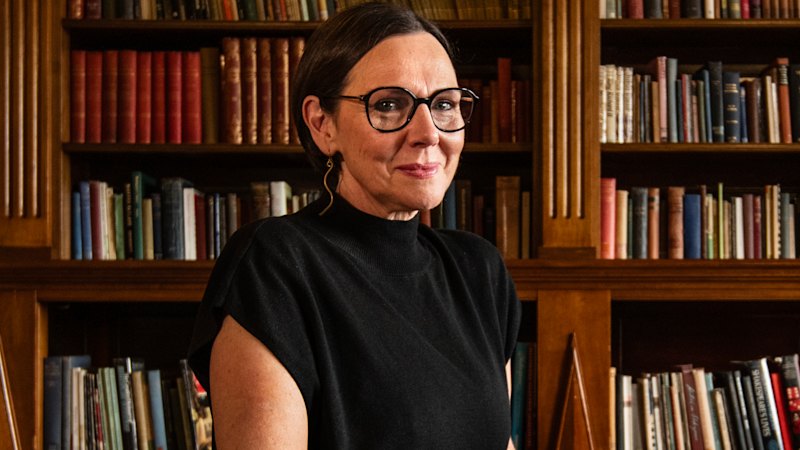
Because she spent six years writing Dictionary of Lost Words and Bookbinder of Jericho, Pip Williams was determined her next book would be a simple tale of love.
The German Ward, released next week, is indeed a love story but, like New York Times bestseller Dictionary, it explores multiple themes from many perspectives.
“In the end, it seems I’m incapable of writing just a simple, single storyline; it’s again a layered story. But at its heart, it is all about desire, the desire for something – and every character desires something,” the Adelaide-based author says.
Set in Etaples in France during World War I, the book’s central character is the actor and suffragette Tilda Taylor, who readers may recognise from Bookbinder of Jericho. During research for that novel, Williams was looking at work by Australian artist Iso Rae, deep in the archives of the Australian War Memorial (AWM).
Rae and her family lived in the northern riverside town, which swelled to house 100,000 troops by 1917. As well as helping in army base hospitals - 20 general hospitals served the wounded from the Somme battlefields - she documented what she saw. While never an official war artist, that work has become her best known; about 19 pieces are held at the AWM.
Those drawings provided Williams with information she couldn’t find in the written records. “It’s happened in all of my novels. A lot of the information that helps me furnish that history, that time and place, actually comes from women’s art, whether it’s poetry or memoir or visual art,” she says. “I get so much from that kind of archival material compared to official records, and that’s often because the official records don’t pay much attention to women’s lives, whereas women pay attention to their lives, their surroundings, what affects them.”
The drawings gave her a sense of the place in which Rae lived and worked - crucial, because it was where she had sent Tilda in Bookbinder. “I wanted to be able to understand where the letters were coming from that Tilda was writing to the main characters in that previous novel.”
The latest book’s title refers to the ward that housed injured Germans soldiers. Like many elements of the story, the ward existed. As did the Voluntary Aid Detachments, known as VADs, who worked alongside medical staff in such camps, tending to patients and often doing the work of nurses.
While Rae worked as a VAD and was a prolific artist, she is fictionalised in the book. Born in Collingwood, she studied at the National Art School, and, in 1887, her family moved to Paris. They moved to the French village in 1890, then home to an artist’s colony, and remained there even when war broke out because her mother was too frail to move.
As a social scientist turned novelist, Williams’ first career informs her writing: where possible, truth informs events, places and people. In Dictionary of Lost Words, for example, every word featured is an actual word. “My adherence to the known facts is ingrained, which is why my author notes are so extensive. Because I’ve spent 25 years having to acknowledge my sources,” she says.
Williams has no problem writing about and imagining real people but she has a particular approach to doing so. “Anything I know of them, I try very hard to be true to that understanding of them, whether it’s their nature, their humour, their particular moral code.”
“If there isn’t enough information, then I will respectfully imagine more, based on what I’ve got.”
She argues there is much we don’t know even about our closest friends and relatives. “I don’t think there is an official record of anyone who’s ever lived. So much will be imagined. Even if you’re a biographer or historian, you will be imagining a lot, even if you say you’re not.”
Where the formal documentation differs from a first-hand account, Williams gives priority to the first-hand. For this book, her extensive research included journals, oral histories, memoir, poetry and art. She cites Vera Brittain’s poetry and her memoir Testament of Youth (1933), which details her experience as a VAD during the war, as critical. Iso Rae’s archive was invaluable, plus many other first-person accounts.
She also consulted with “all the usual sources”, museums, archives and galleries, and made two trips to Etaples. When she visited and went for a swim, she realised she had to change one scene - having imagined it was sandy underfoot – when she realised it was silty.
Once she has all the background information, Williams begins to write, heading anywhere but the gorgeous, purpose-built room lined with bookcases attached to her home in the Adelaide Hills, which her husband built a few years ago. “I cannot write in there. There’s so much pressure.”
Instead, she spends hours tapping away at her keyboard in cafes: “It gives me a sense that I’m not working.”
Often asked why she writes historical fiction, Williams says it wasn’t the genre she was drawn to but an interest in the Oxford English Dictionary. Specifically, she wondered whether it was a gender-biased project.
Once she was in that time and place in her mind, and doing research in the archives, she would come across other ideas that captured her imagination. “The second book just came out of the serendipity of being in the archives and coming across what I thought was another good story, and also another good question. For me, it’s not always that it’s a good story – it’s that the question is engaging.”
Others clearly agree with how engaging that idea was: The Dictionary of Lost Words was adapted as a stage show by State Theatre Company South Australia and Sydney Theatre Company in 2023, to great acclaim. This month, the same team has announced Bookbinder of Jericho is next with a co-production between State Theatre Company South Australia, Sydney Theatre Company and Arts Centre Melbourne set to premiere in Adelaide next year.
Dictionary is also optioned for adaptation to the big screen by South Australian-based Highview Productions, who will partner with British producers.
While The German Ward is her third published book, Williams has a cheeky “back-up novel” started before Dictionary that she likens to the boyfriend you keep going back to in between other, more interesting lovers.
Desire is a through line in all of her books. While we often think of desire in relation to love, Williams says her main characters all have an intense desire for something else: knowledge. “Weirdly, I’ve had it in my previous novels without being able to articulate it.”
“If there was ever a love triangle in my previous novels, it was between my [main characters’] … love of a man but also their love of knowledge, or a career, or to be able to pursue something. In those times, that was often in conflict with marriage and children, and so their desires were in competition.”
In The German Ward, there is one contemporary character, the curator Eva, who is going through Iso Rae’s archives, trying to understand the artist through her work. Eva also wants to be observed, says Williams. “She’s desiring love and affection and all of those things as well, and she’s seeing it in the artwork … which is why she’s so engaged with it – because she’s seeing something that she longs for.”
Eva’s character is autofiction, reflecting the thought processes and questions Williams has about the artist. Clearly compelled to document what she witnessed, almost all of Rae’s work done during the war has “almost journalistic” detail explaining it.
In the Rae drawing owned by the author, a third of the image is taken up with where it was done and who it features. “I think in real life, drawing and art was her way of processing that place and time,” says Williams.
A recurring image throughout Rae’s sketches imagined by Williams, is of two hands held up, one male, one female, not quite touching. It’s a powerful visual and a metaphor for the love in the novel, between Tilda and the German doctor, who is also a prisoner of war.
“Everything is conspiring to keep you from it, which of course heightens your desire for it. All of us have probably had an experience whether it’s with a person, or with food, or with an adventure, or travel, or whatever it is, it’s the anticipation that you get leading up to the thing that you want that is so charged,” she says.
“Tilda’s desire is really obvious. She desires Hugo, but she’s also desiring sensation because her response to the war and her experience is a numbing, if you like, which is a typical PTSD response.”
Watching conflicts in Gaza, Ukraine and other places around the world, Williams was struck by images of health care workers. She wondered how they maintain their humanity in the face of these unbearable situations. “Do they still laugh? Do they still celebrate things? Do they still fall in love?”
She read a news report about an Australian doctor who volunteered in Gaza, fell in love and married a Palestinian. “Even in the worst of times, there are some human emotions and desires that somehow can cohabit. And then I thought, well, maybe it’s not about cohabiting, maybe it’s about genuine need. We need to be able to keep loving and desiring in order to survive these times.”
All that becomes part of the way Williams writes the story. Fundamentally, she says, humans haven’t changed. We are no different to how we were 100 years ago, or even 1000 years ago: we still have the same emotions. “The emotions aren’t modern, the emotions are ancient.”
“I’m telling the story of two people and the people around them, and that’s when you can see the humanity in everybody, regardless of the colour of their skin, or the language they speak, or the religion they follow, or the uniform that they wear,” she says.
“The hospital ward was perfect because they’re just all in pyjamas, and [the German patients] want what the British/Australian/Canadian/New Zealand patients want. They want water. They want their mother. They cry. They do all the same things the patients in other wards are doing.”
The German Ward is out now via Simon & Schuster.
The Booklist is a weekly newsletter for book lovers from Jason Steger. Get it delivered every Friday.
You have reached your maximum number of saved items.
Remove items from your saved list to add more.
Citations · 2 reports from 2 outlets
Tap a citation to read it above, right here on T.A.M.
New York Times bestseller confesses: I can’t write a simple love story
The author of Dictionary of Lost Words has a cheeky back-up novel in her drawer that she likens to the boyfriend you keep going back to between other, more interesting lovers.
1 hour ago · Kerrie O'BrienNew York Times bestseller confesses: I can’t write a simple love story
The author of Dictionary of Lost Words has a cheeky back-up novel in her drawer that she likens to the boyfriend you keep going back to between other, more interesting lovers.
1 hour ago · Kerrie O'Brien