
Poison umbrellas, exploding telephones: Inside the epicentre of Cold War spying
The German Spy Museum in Berlin is surely the most entertaining way to get to grips with this Cold War capital.
First reported 1 hour ago · latest update 1 hour ago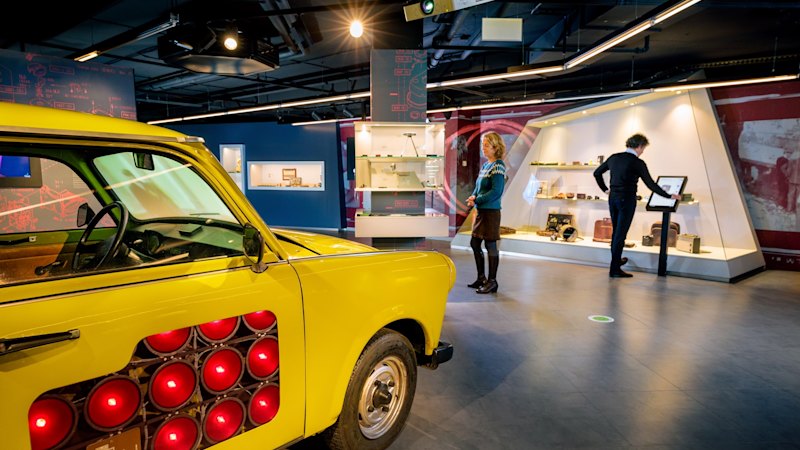
I dare say I’ve learned a lot in my decades of travel but, until now, never how to crack a safe, fool a lie-detector machine, or conceal a recording device in the heel of a shoe.
While I doubt these skills will prove useful, they certainly entertain me and, at the same time, educate me about the Cold War. That in-between period of black-and-white politics might now be consigned to history, but it dominated my teenage years.
Reliving it brings a curious mix of incredulity and nostalgia. If you remember the Cold War, you’ll love the German Spy Museum. If you don’t, you’ll discover what a weird world your parents or grandparents inhabited up until the Soviet Union fell apart in 1991.
The museum is appropriately located in Potsdamer Platz, once bisected by the Berlin Wall and still retaining its fragments. Berlin, divided between east and west and the epicentre of Cold War espionage, was a hotbed of agents and double agents.
A museum touchscreen with an interactive map that pinpoints all their known Berlin operation centres and safe houses erupts in an astonishing rash. Spies, it seems, were everywhere, not just in John Le Carre novels.
Sign up for the Traveller Deals newsletter
Get exclusive travel deals delivered straight to your inbox. Sign up now.
A whole gallery is devoted to the period’s most notorious spies, spymasters and assassins, some of whom talk on camera about their craft and experiences.
Among the figures given potted biographies are British double agent Kim Philby, who defected to Moscow in 1963, and Bulgarian dissident Georgi Markov, murdered in 1978 by poisoned umbrella in London.
The umbrella is replicated in the museum alongside other objects that would seem ridiculous if not so fatal: a gun disguised as a cigarette lighter, a British secret-service pistol shaped like a tobacco pipe, and poisoned pills.
The technology is almost absurd now, and some ideas seem straight from the laboratory of Ian Fleming’s Q: cameras inside watering cans and lipsticks; radio transmitters disguised as buttons; a Trabant car with concealed infrared lights.
All these objects are the real deal, but the museum also takes a more playful look at spies and assassins in pop culture. You can admire an outsized suit worn by the character Jaws in two James Bond movies, and find out how the cryptex featured in The Da Vinci Code worked.
Code cracking is part of what makes the German Spy Museum so interactive. Visitors can tackle various codebreaking puzzles or let a computer algorithm guess their favourite password. To the alarm of many, it sometimes takes just a few minutes.
Code cracking is put in a wider historical context, too. I enjoy using a scytale cipher of the type that created coded messages in ancient Greece, studying the substitution cipher favoured by Julius Caesar, and inspecting rotating cipher discs invented during the Renaissance.
Modern-day internet hacking is covered as well, with figures such as Edward Snowden and Julian Assange bringing the story right up to date.
If you have children, they won’t be wowed by adult themes such as Cold War politics and modern surveillance but, as you delve in, they can enjoy other aspects of the museum.
The safe cracking, which requires careful listening to the clicks of the lock wheel, is fun. So is the search for bugs in a simulated office of retro furnishings, in which the typewriter and dial telephone now look like artefacts of an alien civilisation.
The most popular activity is one in which aspiring burglars must attempt to cross a room protected by laser beams without tripping alarms – and all while beating other visitors’ times. A useful skill? Surely not, but a great way to enliven a visit to a fascinating museum.
SEE The German Spy Museum is open daily 10am-8pm. Dynamically priced tickets cost between €8 and €18.50 ($13-$30) with a specific time slot for arrival. See deutsches-spionagemuseum.de
STAY Lux Eleven Berlin-Mitte has big designer rooms with kitchenettes in a building once occupied by the KGB. From €150 ($244) a night. See lux-eleven.com
FLY Singapore Airlines flies to Berlin via Singapore and Frankfurt. See singaporeair.com
The writer travelled courtesy the German National Tourist Office and Visit Berlin. See visitberlin.de
You have reached your maximum number of saved items.
Remove items from your saved list to add more.
Citations · 2 reports from 2 outlets
Tap a citation to read it above, right here on T.A.M.
Poison umbrellas, exploding telephones: Inside the epicentre of Cold War spying
The German Spy Museum in Berlin is surely the most entertaining way to get to grips with this Cold War capital.
1 hour ago · Brian JohnstonPoison umbrellas, exploding telephones: Inside the epicentre of Cold War spying
The German Spy Museum in Berlin is surely the most entertaining way to get to grips with this Cold War capital.
1 hour ago · Brian Johnston