
Moses went to adult prison at 18. Now he’s voluntarily going back behind bars
Warning: Distressing content and images. Jailed as a teen, Moses Riek hopes lessons from his past can keep a new generation out of trouble.
First reported 1 hour ago · latest update 1 hour ago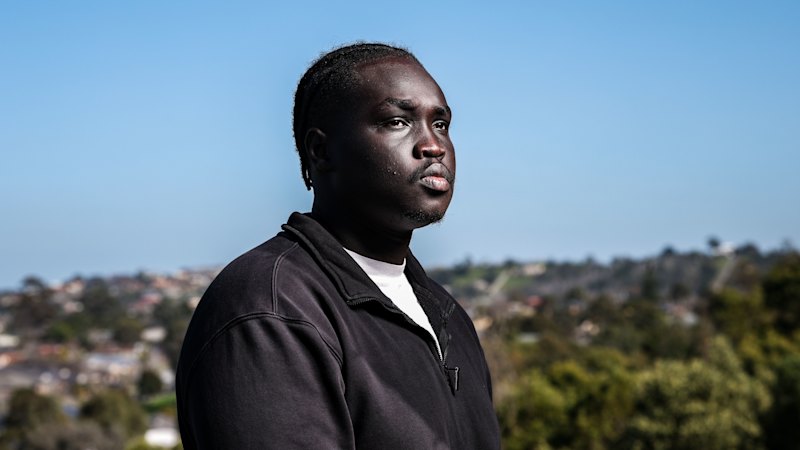
Hanad Hersi, co-founder of Think Village, takes his programs straight to the kids in their classrooms. He says that youth offending is a confronting subject, but speaking to children and their families about the signs of grooming and exploitation is crucial to winning the war against organised crime.
“We know from the conversations we’re having with young people, kids as young as 12 are being recruited into organised crime,” Hersi says.
“These crime groups are tasking these kids to do firebombings, home invasions, carjackings. We’ve actually done a number of targeted sessions for parents about this, and this is the first time any organisation, any service or group has ever spoken to them about grooming and exploitation.”
Hersi says parents need help to understand when their child is a target. Being taught about the warning signs gives them the tools to intervene.
“We’ve been working with VRU to support some of those families,” he says. “These things are happening, so how do we equip the sector to be able to adapt and mobilise and get to young people before it’s too late? Most importantly, how do we support parents and young people themselves, so their kids don’t get coerced and groomed and exploited?”
Several years after his own release from jail, Riek is now trying to help at-risk teens avoid the same fate. Prison, he says, was a wake-up call, and he doesn’t want to see any more members of his community end up in a life of violence.
“I was in and around that that sort of gang culture, and I knew everything that was going on. I could see some very easy solutions to some very big problems,” he says.
Now, an average week for Riek involves regular trips to youth facilities in Little River and Parkville, as well as speaking at conferences and at schools. He tells them what his life looks like now, giving them the perspective and knowledge he wishes he had as a teenager.
“Every week I come up and talk to them about something new, and that’s where I get the most contact with all the boys in the system,” he says. “They just want that guidance, and someone that cares for them.”
While prevention is an important part of fixing the state’s youth crime problem, victims say there also needs to be real consequences for violent actions, especially where children are old enough to know what they’re doing.
Warning: Distressing content and images
On July 19 last year, Saurabh Anand picked up medication from a chemist in an Altona Meadows shopping centre just moments before a group of teens he’d never met launched an unprovoked, vicious attack.
“I had never seen them ever in my life,” Anand tells this masthead. “They just jumped on me from behind. I told them I didn’t want any trouble, and that I had nothing on me. They surrounded me completely and started looking through my pockets. That’s when one pushed me from behind, and they started bashing me.”
Anand tried to protect his head and body as the teens thrashed at him. Then, one pulled out a machete. Within minutes, one of the boys had gone for Anand’s throat, and instead sliced through his left hand, between his thumb and first finger, cutting all the way up his forearm.
Nobody intervened in the attack and it took nearly an hour for emergency services to arrive, Anand says. Another teenage boy found Anand covered in blood after the attack and ran to get help. Paramedics would later tell Anand that his hand was barely attached, hanging by a small amount of skin.
He spent hours in surgery as neurosurgeons and plastic surgeons worked desperately to save his hand. Fifteen months later, he is still unable to move two fingers, and expects a lifetime of pain.
The teenagers responsible for the attack were all arrested in the days that followed. Four were immediately released on bail. Anand said that when the case went to court, all five were released without jail and the court noted they were remorseful for their actions.
“It is a huge setback to rely on a judicial system that feels broken because there are gaps in it. It isn’t able to hold accountable these people who are actually wielding weapons and attacking people,” he says.
“And I’ll be honest with you, no matter what the age is for a teenager, everyone does have that psyche that if you jump off a wall, you might just get hurt by falling down. How is it that there isn’t then enough understanding that if you’re holding a weapon and if you use that on someone, that person may die. I think it’s that simple.”
The answer to youth violence, Anand says, doesn’t sit solely with prevention. In his experience, the kids responsible for his attack “knew” what they were doing, and mid-teen years is too far gone to rehabilitate.
“To sit someone like that in a rehab program doesn’t fix the problem,” he says. “If you’re telling me that a 14-year-old kid is going to get therapy when he has already had an experience of attacking someone, and he knows that he gets away with it every time he does that, what good will an hour a week do?
“If you are saying that you’re going to rectify that with just a rehab program, I doubt that you have enough support workers to actually fund an entire community, or entire state. Setting them free in the community is not the answer because what it is doing is giving them the licence to kill, licence to steal, licence to do anything they want without any consequences.”
Riek agrees that there needs to be accountability, but emphasises that’s what makes lived experience work so important.
“I think there are kids that think they know what they can get away with,” he said. “But they don’t actually know the real risks.”
He thinks back to the kid in the cell on his first night in custody.
“At the start, no one really jumps into the serious offending. You find yourself getting deeper entrenched in negative circles, and the people who are in the gang culture.
“I haven’t really seen any evidence that shows locking up kids is going to be the answer. But when you mix both accountability and prevention, that’s the sweet spot, really.”
Start the day with a summary of the day’s most important and interesting stories, analysis and insights. Sign up for our Morning Edition newsletter.
Citations · 2 reports from 2 outlets
Tap a citation to read it above, right here on T.A.M.
Moses went to adult prison at 18. Now he’s voluntarily going back behind bars
Warning: Distressing content and images. Jailed as a teen, Moses Riek hopes lessons from his past can keep a new generation out of trouble.
1 hour ago · Isabel McMillanMoses went to adult prison at 18. Now he’s voluntarily going back behind bars
Warning: Distressing content and images. Jailed as a teen, Moses Riek hopes lessons from his past can keep a new generation out of trouble.
1 hour ago · Isabel McMillan