
‘Work is getting harder and harder to find’: On the street with China’s gig workers
Beijing’s largest temporary job market is one way to gauge the economic reality of ordinary people at the bottom of what analysts increasingly refer to as China’s K-shaped economy.
First reported 59 minutes ago · latest update 59 minutes ago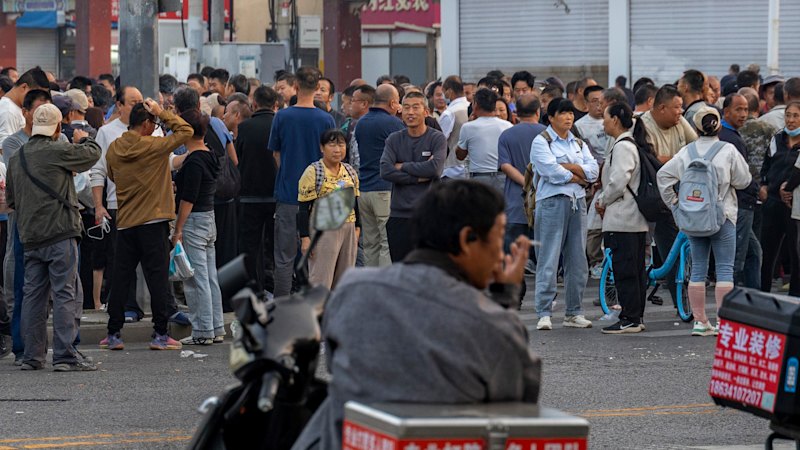
Before coming to Majuqiao a month ago, Yang was working as a day labourer in Wuhan, where he says recruiters would offer hourly rates as low as 16 yuan ($3.40). But there’s a reason for so many farmers to leave their villages.
“You have to farm a lot of land before you can really make money,” Yang says.
This is just a snapshot of the precarious existence faced by millions of China’s lowest-paid workers. But it aligns with the insights recorded by Cong Rui’an, a PhD student at Beijing’s elite Tsinghua University. Cong spent eight years regularly taking gig work at Majuqiao to study worker conditions before publishing a book on his research this year.
“There are still plenty of jobs in Majuqiao, but fewer and fewer of them are worth choosing,” he says in a recently translated podcast interview.
There is a high turnover, as workers arrive from distant hometowns only to be demoralised by the pay and conditions. They resort to saving enough to leave to find better work elsewhere, meaning the jobs constantly available at the labour market tend to be the worst ones, he says.
Cong describes factory work as particularly gruelling and often dehumanising.
“People are constantly scolding you, and both your body and mind gradually become numb,” he says.
“The employer wants you to sell your labour power and nothing else. Your other feelings, your dignity and your needs are irrelevant to them.”
By 8am, Li Qingliang, 60, has given up on the morning market and is walking back to his room, carrying a saw and a plaster scraping tool, and with a large bag slung over one shoulder.
He’s been working in construction for 30 years, though his wife has remained behind in their village in Henan province, where she farms their small plot of land and raises their grandchild.
“Nowadays, construction sites funded by the government turn away over-aged workers. So now, whenever there’s work, I take it. I’ll earn as much as I can for as many days as I can,” Li says.
Again, another passerby eavesdrops on our conversation and throws into the mix: “If you’re doing an interview, just tell the truth and lay out all the downsides. Don’t just talk about the positive things.”
With the property boom over, construction work is harder to come by, Li says, but his outlook is more sanguine than others’.
“I feel it’s all fine. Anyway, as long as I can earn a few thousand yuan a month, that’s enough, right? Buy some food to eat, work when I feel like it and rest when you don’t feel like it. It’s pretty free,” he says.
Li agrees to show us his living quarters, a room of 10 square metres he rents for 500 yuan ($105) a month. But as we follow him down an alleyway, another man on a bicycle comes up behind us. He’s been trailing us for a stretch, and he’s displeased by what he’s heard.
“Don’t go on TV. Don’t f---ing lose your mind. Does your family know what you’re doing?” he yells at Li, wrongly assuming we’re doing a televised interview.
Damage done. Li is rattled and says his landlord might be unhappy if he brings a foreigner to his room.
We thank him for his time and walk back to the intersection. The crowds are thinning as people disappear into their dormitories to wait for the afternoon to roll around and the night shift recruiters to arrive.
Get a note directly from our foreign correspondents on what’s making headlines around the world. Sign up for our weekly What in the World newsletter.
Citations · 2 reports from 2 outlets
Tap a citation to read it above, right here on T.A.M.
‘Work is getting harder and harder to find’: On the street with China’s gig workers
Beijing’s largest temporary job market is one way to gauge the economic reality of ordinary people at the bottom of what analysts increasingly refer to as China’s K-shaped economy.
59 minutes ago · Lisa Visentin‘Work is getting harder and harder to find’: On the street with China’s gig workers
Beijing’s largest temporary job market is one way to gauge the economic reality of ordinary people at the bottom of what analysts increasingly refer to as China’s K-shaped economy.
59 minutes ago · Lisa Visentin