
This play was banned in the 1930s. Now it’s coming back
This show once subverted a ban by being performed on the back of a truck. It returns as part of this year’s Melbourne Fringe.
First reported 1 hour ago · latest update 1 hour ago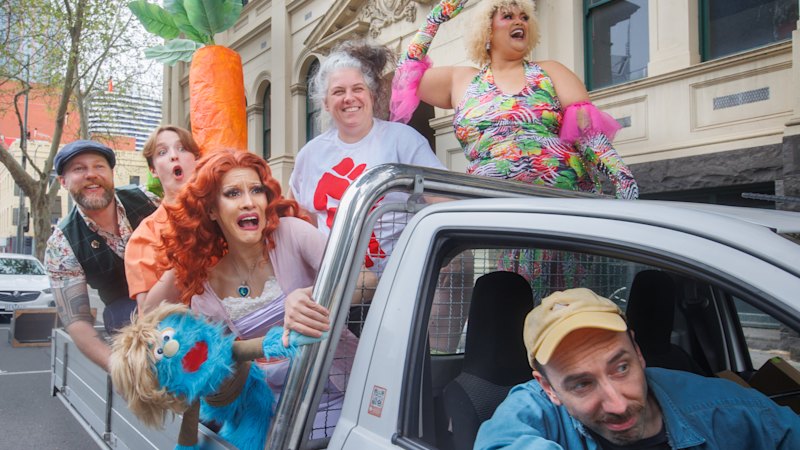
In 1936, a planned staging of a play called Till The Day I Die was banned in Melbourne – because of how it portrayed the Nazis.
The German Consulate had lobbied the then-federal government with their complaint So, the Melbourne-based New Theatre group got around the ban by performing the show on the back of a flat bed truck – which could quickly be moved if police approached.
This month, as part of Melbourne Fringe, the show is coming back – and in a nod to the past, this version will be staged in part on a flatbed ute.
Katie Sfetkidis and Mark Wilson were at a New Year’s Eve party when they began discussing staging Till The Day I Die, the countdown mirroring the urgency the old friends felt about the idea.
“It just became clear that we had to do it, and that it was speaking to now so potently, kind of almost absurdly,” says Wilson.
The play protests the rise of Nazism and was written by American Clifford Odets in 1935. It’s become more relevant in some ways, says Sfetkidis, which is “kind of scary and absurd”.
A real force in American playwriting, Odets is rarely performed locally. But according to the show’s directors, his writing is brilliant, his control of tone and content extraordinary.
Sfetkidis says it’s also very funny: “One minute, you’re laughing at how silly someone is and then the next minute, you’re watching something incredibly horrific. Both things [are] happening throughout the play and that’s the mastery of the way Odets has been able to craft such a great script.”
There are clearly good guys and bad guys in the work, says Wilson, but it is also interested in the contradictions within far-right ideology. No two of the characters who are Nazis are for the same reasons, and so the internal contradictions of the ideology are really laid bare, he reflects.
Sfetkidis came across the play as part of her research into the history of protests in the City of Yarra. She is about to take a deep dive into the history of the New Theatre group as part of a fellowship at Arts Centre Melbourne.
When they tried to perform Til The Day I Die at Collingwood Town Hall in 1936, she says, about 2000 people had gathered on the streets outside, blocking Hoddle Street, all trying to get in to see the show.
Sfetkidis says she was keen to use theatre as a tool to start a political conversation around the rise of fascism. “Actually talking about it openly in all its complexity is really important,” she says. “Witnessing it in ways that are not obvious, [that are] more complex and complicated than just being outraged or upset.”
“We need to get beyond outrage, as Katie says, and think about how to stop this stuff,” says Wilson.
Several people told the co-directors that the show’s subject matter is “too hot” to produce at this moment in time. “We now live in this world where people, for many reasons, are afraid to speak truth or speak about things that are happening,” says Sfetkidis.
In rehearsals every now and then, Wilson explains, someone is overwhelmed by how much was known about what the Nazis were doing, even in the 1930s: “It’s an ugly thing that the world knew so much so early.”
The subversive play is one of more than 450 events at this year’s Melbourne Fringe Festival, which kicks off today. It is Victoria’s longest-running multi-arts festival and one of the largest in the country.
Returning to celebrate its 10th year is Deadly Fringe, the First Nations commissioning program, headlined by Dhandha/Campfire by Joel Bray Dance, a free, daily participatory event at Fed Square, with light, music and dance. Radical Access, which reimagines accessible art making, led by deaf, disabled and neurodivergent creatives, is also back.
So too is Weekly Ticket Footscray, which sees David Wells improvise, dance, talk and collaborate with commuters and other artists at Footscray Station. It’s a remarkable 15-year community project by Wells and other artists who have been involved with Melbourne Fringe since 1983.
In a nod to Melbourne’s Carrot Man, Hayley Edwards will present The Carrot Show, a joyous, absurd new work, while internet sensation James Ward appears in Harold Holt: The Man, The Myth, The Pool, a show built around a replica of the Harold Holt Swim Centre.
Milo Hartill appears in a show she describes as “part cabaret, part song-cycle and part influencer-takeover”, called Black, Fat and F**gy.
Trash Wizard, a camp, absurdist post-humanist dark comedy complete with puppets, will be staged at La Mama, written by Charlie Star with Em Tambree, while Kelly Lim Harris will share outrageous stories from her life in Yellow Fever: An Original Musical Cabaret, dissecting that term’s origins and linking them with her experiences as an Asian performer.
This year Fringe will also head north-west for four days of Fringe Encore: Ballarat. It will host two exclusives, Sammy J Hero Complex – first staged at Fringe nearly a decade ago – and Fountain Lakes: Y2K, starring Art Simone from RuPaul’s Drag Race Down Under with Thomas Jaspers and Jemima Handful.
Elsewhere in Ballarat, catch Elaine Crombie (Top End Wedding, Nowhere Boys) performing in Grief, Love and Lead Balloons – also running during the Melbourne Fringe – and the Na Djinang Circus.
The restaging of a banned play with an incredible resonance for the world today is a neat refocusing on politics at the Fringe Festival, which includes art of all kinds. Wilson says it reflects part of this city’s rich history of protest.
“We tend to forget that Melbourne has always been a very radical city with a really, really strong radical art scene and a really strong activist scene,” he says. “Certainly our lives have been influenced by that radicality in both the art scene and the activist scene.”
Till The Day I Die is at Trades Hall from October 1-4. Melbourne Fringe Festival runs from September 29–October 18 with Fringe Encore: Ballarat from October 22-25.
The Booklist is a weekly newsletter for book lovers from Jason Steger. Get it delivered every Friday.
You have reached your maximum number of saved items.
Remove items from your saved list to add more.
Citations · 2 reports from 2 outlets
Tap a citation to read it above, right here on T.A.M.
This play was banned in the 1930s. Now it’s coming back
This show once subverted a ban by being performed on the back of a truck. It returns as part of this year’s Melbourne Fringe.
1 hour ago · Kerrie O'BrienThis play was banned in the 1930s. Now it’s coming back
This show once subverted a ban by being performed on the back of a truck. It returns as part of this year’s Melbourne Fringe.
1 hour ago · Kerrie O'Brien