
ASX to open flat ahead of RBA rate call; Wall Street wobbles as bonds spike
The Australian sharemarket is set for a cautious start on RBA day, with investors looking to the Reserve Bank’s press conference after its expected rise in interest rates for clues on whether a follow-up hike will be needed.
First reported 1 hour ago · latest update 1 hour ago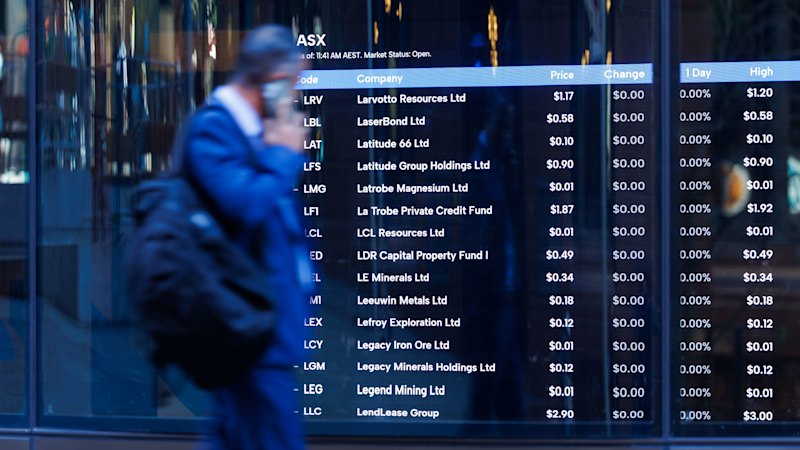
The Australian sharemarket is set for a cautious start on RBA day, with investors looking to the Reserve Bank’s press conference after its expected decision to raise interest rates for clues on whether a follow-up hike will be needed.
ASX futures were up 2 points at 8722 as of 6.39am AEST. The local bourse rose 0.2 per cent on Monday, with a slump in miners counterbalancing rallies in banks, and defensive sectors such as utilities and health care. The Australian dollar traded at US70.17¢.
The Reserve Bank’s nine-member policy board will increase the cash rate by a quarter-percentage point to 4.6 per cent, the highest level since November 2011, in its decision announced at 2:30pm in Sydney, economists widely predict. Traders are also pricing an end to the RBA’s two-meeting pause, against a backdrop of spiralling energy prices across the global economy.
Investors will closely scrutinise both the rate statement and RBA Governor Michele Bullock’s press conference an hour later. They’ll be seeking clues on whether the central bank is prepared to deliver back-to-back hikes in November or prefers to watch and wait through the rest of the year.
“The risk sits with the need to tighten monetary policy further beyond September given the inflation backdrop,” said Belinda Allen, head of Australia Economics at Commonwealth Bank of Australia. “But it is not an easy decision to push monetary policy further into restrictive territory.”
The central bank has stood pat at 4.35 per cent since May after opening the year aggressively, with rate rises at each of its first three meetings.
On Wall Street overnight, yields in the US bond market cranked up and again reached their highest levels in roughly two decades, which knocked stocks further from their record high.
The S&P 500 fell 0.8 per cent and gave back much of its gain from last week, which had brought it to the brink of its all-time high. The Dow Jones Industrial Average finished down 0.7 per cent, and the Nasdaq composite lost 0.9 per cent.
US stocks felt pressure as the yield on the 10-year Treasury jumped to 5.23 per cent from 5.17 per cent late on Friday. That’s a considerable move for the centrepiece of the US bond market, taking the 10-year yield back to where it was in 2007, before the global financial crisis sent yields toward zero.
Treasury yields have been jumping for a range of reasons, from worries about Washington’s massive debt load to rising energy costs from the Iran war, which boost inflation. That pressures the economy because it prompts higher interest rates, making borrowing money more expensive for everyone, while also undercutting prices for stocks and other investments.
Monday’s rise in yields followed the latest swings for oil prices, which have been yo-yoing on uncertainty about when the war with Iran will allow tankers to flow freely again through the Strait of Hormuz and deliver oil from the Middle East to customers worldwide.
The latest turns came after President Donald Trump over the weekend rejected an offer from Iran to reopen the Strait of Hormuz and resume talks on its nuclear program.
“I’d like to make a deal, too,” Trump said Saturday. “But that deal would not be acceptable.”
West Texas Intermediate futures settled below $US93 a barrel, up 0.5 per cent, after a day of choppy trading, which saw it rising by as much as 4.5 per cent during the session. Brent was up 1.3 per cent at $US105.71 a barrel.
Trump is willing to give Iran sanctions relief and release frozen funds for concrete progress on the nuclear issue, according to a US official. Iran’s nuclear program is a key sticking point for both sides.
Traders have been parsing conflicting signals on progress towards a US-Iran ceasefire and a reopening of the vital waterway. Bloomberg reported that Iranian officials have privately expressed pessimism about reaching a deal to before the US midterm elections in November.
Trump said that talks with Iran were held on Monday through mediators. The US president earlier rejected a proposal by Tehran to reopen Hormuz if Washington made some concessions. The stark shift in tone over the span of a day highlights the whiplash-inducing rhetoric traders have had to navigate since the conflict began seven months ago.
“Without a concrete deal or conclusion to the conflict, the market is quickly fading initial headline reactions and higher prices are becoming harder to shake,” said Ryan McKay, senior commodity strategist at TD Securities. “The market is increasingly worried about escalation via Iran or the Houthis prior to midterm elections, or from the US post midterms.”
On Wall Street, stocks of airlines and other companies with big fuel bills sank because of the rise in oil prices. American Airlines fell 2.5 per cent, and United Airlines lost 2.2 per cent.
Gold miners were also weak after the price of gold sank 3.9 per cent. Gold has a reputation for helping to protect its investors from high inflation, but its price tends to weaken when rising yields mean bonds are paying investors more in interest. Gold struggles to keep up because it pays its investors nothing.
Nvidia, Wall Street’s most influential stock, rose 1.7 per cent. The chip company said it approved a plan to send up to another $US150 billion to its shareholders in a stock buyback plan, bringing the program’s total remaining size to $US235 billion.
Nvidia has the power to do so after the frenzy around its chips used for artificial-intelligence technology helped it more than double the amount of cash on its books in the first half of its fiscal year. The company also on Monday unveiled a new security platform that the chipmaker said can stop artificial intelligence agents from going rogue.
AI stocks have broadly come under pressure after leaders of the industry said it needs to slow its development to give safety measures time to catch up.
In other international markets, European indexes were mixed following weaker performances across much of Asia. Indexes dropped 2.7 per cent in Seoul and 1.7 per cent in Shanghai for two of the world’s bigger moves.
The Business Briefing newsletter delivers major stories, exclusive coverage and expert opinion. Sign up to get it every weekday morning.
You have reached your maximum number of saved items.
Remove items from your saved list to add more.
Citations · 2 reports from 2 outlets
Tap a citation to read it above, right here on T.A.M.
ASX to open flat ahead of RBA rate call; Wall Street wobbles as bonds spike
The Australian sharemarket is set for a cautious start on RBA day, with investors looking to the Reserve Bank’s press conference after its expected rise in interest rates for clues on whether a follow-up hike will be needed.
1 hour ago · Staff writersASX to open flat ahead of RBA rate call; Wall Street wobbles as bonds spike
The Australian sharemarket is set for a cautious start on RBA day, with investors looking to the Reserve Bank’s press conference after its expected rise in interest rates for clues on whether a follow-up hike will be needed.
1 hour ago · Staff writers