
Largest coal mining proposal in state’s history wins approval
Environmental groups are furious at the decision to extend the life of two sections of a Hunter Valley mining operation for 19 years.
First reported 3 hours ago · latest update 3 hours ago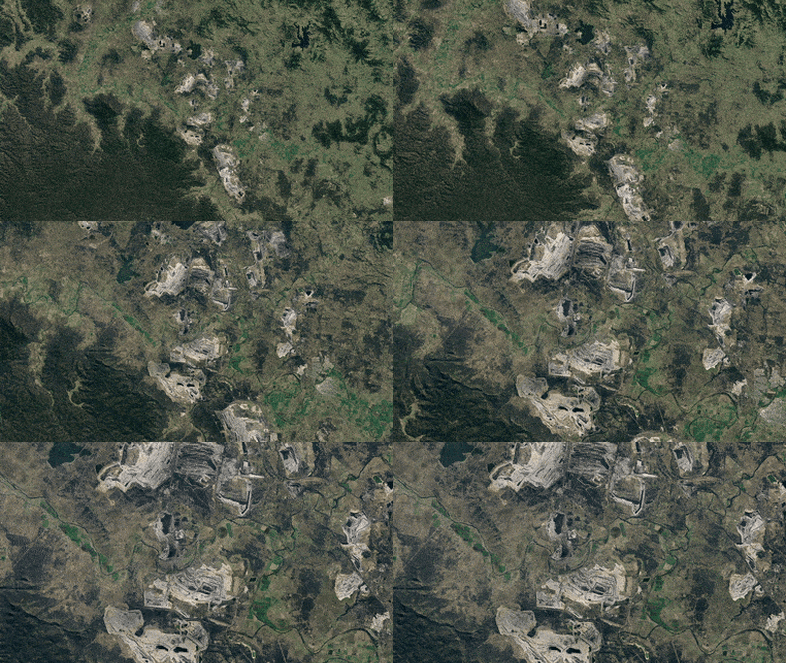
The Albanese government will face a campaign to stop the largest coal mining operation in NSW history after the expansion of two Hunter Valley mines won approval on Wednesday.
After the state’s Independent Planning Commission concluded that the impacts of the Hunter Valley Operations (HVO) project were outweighed by economic benefits, climate groups vowed to put the federal government’s climate credentials under the spotlight.
Australian Conservation chief executive Adam Bandt said it would be a crucial test of the federal Labor government before the global climate summit in November. “It has to step in if it is going to have any credibility to lead those negotiations,” he said.
Federal Climate Change and Energy Minister Chris Bowen will lead negotiations at the COP climate talks in Turkey, while the government is facing criticism from Australia’s Pacific neighbours for fossil fuel project approvals.
In approving the expansion of two sections of the Hunter Valley mining operation for 19 years, known as the HVO extension, the Independent Planning Commission admitted the 810 million tonnes of greenhouse gas emissions will have impacts on the Hunter Valley, but said they could be managed.
It has directed the operation’s owners – miners Yancoal and Glencore – to export the coal only to countries with strategies to limit emissions in line with the goals of the Paris Agreement, and to develop a plan to reduce emissions from the mining operation itself.
“The commission finds that the residual impacts of the project are, on balance, outweighed by its benefits to the Hunter region and NSW, including continued employment, economic activity, support for local business, ongoing royalties and taxation revenue.”
The Minns government lauded the IPC’s decision as “common sense prevailing”, saying it provided security for the mine’s 1500 jobs. NSW Natural Resources Minister Courtney Houssos denied the approval was inconsistent with the government’s climate goals.
“But it’s clear through our coal industry document 2026 to 2050, we set a clear framework where we can meet net zero emissions targets and support important regional coal mining jobs. It’s not one or the other,” she said on Wednesday afternoon.
“Our government is the only government that can meet both of those agreements.”
Environment groups responded furiously. Georgina Woods, NSW co-ordinator for Lock the Gate, said it was a betrayal of the Hunter Valley community and evidence of institutional failure in a state that is already off track to meet its own legislated emission reductions of 50 per cent by 2030 and 70 per cent by 2035.
“Burning the coal produces the pollution that causes the warming,” she said. “The only way to prevent that from happening is not digging up the coal and burning it.”
Last month, the United Nations conceded the Paris goal of holding warming to 1.5 degrees could no longer be met because of ongoing fossil fuel emissions.
Sue Higginson, the NSW Greens spokesperson for climate change and planning, said the coal mine would generate about 809 million tonnes of greenhouse pollution, including 15.1 million tonnes of direct emissions in NSW alone.
“This is a failure of Labor, they cannot keep approving enormous coal expansions and pretend it is taking the climate crisis seriously. The science, the state’s own climate laws and its independent Net Zero Commission are all pointing in the other direction,” she said.
There was an “enormous question mark” over the legality of the decision, Higginson said, adding she wouldn’t be surprised if a legal challenge materialised.
“While these sorts of legal challenges are very difficult and have a David and Goliath aspect to them, people feel compelled to bring them because these decisions are a matter of life and death,” she said.
Nature Conservation Council chief executive Jacqui Mumford described the decision as Premier Chris Minns’ biggest climate failure.
“This decision shows the NSW government’s complete inability to appropriately respond to the ever-growing climate crisis. Today’s approval protects the interests of two multinational coal companies at the expense of everyone else, as our hope for a safe climate future is eroded one coal mine approval at a time.”
Last year, a court overturned the approval of another Hunter Valley coal mine, ruling that the IPC must take into consideration the local impact on residents of coal from the region being burnt overseas. During deliberations over the HVO extensions, residents and environmental groups made the case that extreme weather caused by climate change was already having an impact.
With the project still needing federal environmental approval, Climate Council chief executive Amanda McKenzie urged the Albanese government to reject the project, saying it would be responsible for signing off on the “biggest, polluting coal expansion in NSW history”.
“Australian voters were promised a government that takes climate seriously. Approving this project would make that hard to believe. It would become the Albanese government’s 38th coal, oil or gas approval since taking office,” she said.
Though the federal environment department does assess mining operations according to a series of environment triggers, climate change is not among them.
The approval of the HVO will be a relief for the Minns government, which is facing an insurgency from One Nation in the once Labor heartland of the Hunter.
Pauline Hanson’s party has attacked the government’s credentials on mining, and Labor strategists fear Cessnock and Maitland are in serious jeopardy, with concerns that neighbouring seats such as Port Stephens and Swansea could also be at risk.
The NSW Minerals Council welcomed the decision, and chief executive Stephen Galilee called for legislation to protect the decision from “activist lawfare”.
“The NSW parliament should protect the HVO approval from any such legal challenge through the passage of legislation validating the approval decision. This would limit the opportunity for activist ‘lawfare’ seeking to overturn the approval,” he said.
Get the day’s breaking news, entertainment ideas and a long read to enjoy. Sign up to receive our Evening Edition newsletter.
You have reached your maximum number of saved items.
Remove items from your saved list to add more.
Citations · 2 reports from 2 outlets
Tap a citation to read it above, right here on T.A.M.
Largest coal mining proposal in state’s history wins approval
Environmental groups are furious at the decision to extend the life of two sections of a Hunter Valley mining operation for 19 years.
3 hours ago · Nick O'Malley, Max MaddisonLargest coal mining proposal in state’s history wins approval
Environmental groups are furious at the decision to extend the life of two sections of a Hunter Valley mining operation for 19 years.
3 hours ago · Nick O'Malley, Max Maddison