
Travelers Explore Japan's Sub-tropical Islands
A travel report details a journey through Japan's sub-tropical islands, noting the distinct contrast to major cities like Tokyo and Kyoto. The trip was impacted by the arrival of the season's first typhoon.
First reported 2 hours ago · latest update 2 hours ago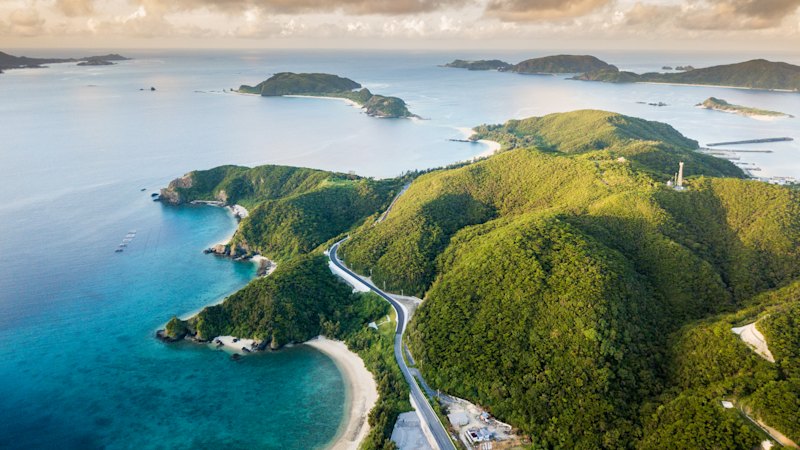
The first typhoon of the season is scheduled to arrive at midday. If all goes according to plan, we will sail into its eye somewhere along Shikoku’s southern seaboard.
“My question: how are your sea legs?” asks Captain Pierre-Marie Ducournau.
A nervous titter washes through Le Soleal’s auditorium, where we’ve gathered for a pre-departure briefing. But Ducournau is just teasing. Instead of sailing headfirst from Osaka into the capricious Pacific Ocean, he will instead detour through the truly pacific Seto Inland Sea. It won’t be the last calamity we thwart on this trip.
“We can see Typhoon Jangmi will go fast [up] the east of Japan,” he says. “That will clear our path on the west coast of Kyushu, and thanks to this, we will be able to resume our itinerary in Kagoshima.”
We glide westwards through the night, and dock next morning at Imabari on Shikoku’s northern shore. The world outside the windows of my deluxe suite is ice blue: the millpond sea; the bridges threading together islets on their journey from Honshu; Shikoku’s mountains stacked like frozen waves against the sky. It’s hard to believe a typhoon is about to shred the coast beyond those resolute ridges.
Sign up for the Traveller Deals newsletter
Get exclusive travel deals delivered straight to your inbox. Sign up now.
“Shikoku is well known for its sunlight,” says guide Keisuke Yamamoto. “In Japan, we have four distinct seasons, and maybe we can add a fifth, the rainy season. It’s called tsuyu – plum rain – and it’s arriving soon.”
But we can ward off bad weather by paying our respects to the god of the mountains. We cross the Kurushima Kaikyo Bridge to Omishima Island, wander through the torii gates at Oyamazumi Shrine, and make our petition.
The mountain god to whom this shrine is dedicated is “at the same time the god of the ocean and of navigation”, says Yamamoto. Given Typhoon Jangmi’s proximity, “it’s important for us to start our visit at this shrine”.
The sea is polished as we drift forth overnight. At dawn, the ship slips through the narrow strait separating Honshu and Kyushu and pops like a cork into the Korea Strait. Rain smudges the windows of the observation lounge.
“Ah yes – the rain, the rain,” laments Yamamoto.
But our entreaties to the mountain god will pay multiple dividends by the end of this trip. We bump along Kyushu’s western seaboard, take refuge in Hakata Bay and make our second hastily planned stop at Fukuoka. Cherry blossom-pink buses ferry us to Kyushu National Museum in Dazaifu.
“Thank you for coming in the typhoon – the typhoon!” says guide Yuko Ehara. “Usually, the typhoon season is summer time, but this [springtime] rainy season is very important for growing rice.”
Rice sprouts tremble in the flooded fields, and the glass-encased museum is spattered with raindrops. History is sealed safely inside it: earthenware vessels, sutra containers, fragile scrolls and the fossilised jaw of a Naumann’s elephant, an extinct species from the Pleistocene era. The exhibit was dredged from the Seto Inland Sea in the 19th century.
“We’re just in time to see the typhoon passing,” says Ducournau, as he eases Le Soleal out of Hakata Bay and towards the East China Sea.
Kagoshima Bay comes into sight right on schedule. Sakurajima, an active volcano, squats at its centre, its vent capped not with steam but with white cloud. Once an island, it’s now fastened with a collar of lava to the mainland opposite Kagoshima, from which an around-the-clock ferry service transports the residents still living in the shadow of this volatile formation named, curiously, for the graceful cherry blossom.
“You want to know how many times this year it erupted?” asks guide Mayumi Uchiyama. “So far, around 30 times.”
Most eruptions are insubstantial, but some reshape the landscape: Sakurajima Visitor Centre stands on a lava field formed after an eruption in 1914.
A trail skirts the volcano’s flanks; up close, it looks innocuous with its cloudy scarf and skirt of spruce. But in five days’ time it will erupt violently, blackening the sky and spewing effluvium. Mercifully, there will be no casualties.
But we’re long gone by then, weaving our way through the Ryukyu Archipelago, which arches like a dislocated spine towards Taiwan. Until 1879, these scattered islands were part of the Ryukyu Kingdom. On their northern tip is the UNESCO World Heritage-listed Yakushima, a cupcake of an island layered with subtropical shores, temperate slopes and sub-Arctic peaks.
“Botanists from all over the world come here,” says guide Yuko Ehara. “It’s a miracle island.”
Somewhere in its mountainous middle stands the 1000-plus-year-old Jomonsugi, a sugi (cedar) said to be Japan’s oldest tree. Sugis were once used to make shingles. Now protected, they provide shelter as we move through the forest’s damp, spongy epiphyte-ribbed understorey.
Okinawa begins far south-west of here, a string of 160 isles anchored by the slender, elongated Okinawa Island. By the time we reach it, we’ve managed to shake off Typhoon Jangmi’s residual wisps, but the sky is still chalky, the typically radiant bays a dull turquoise.
The ruins of Nakijin Castle at Motobu in the north seem anachronistic amid the sugar cane and pineapple plantations, the powdery beaches and shallow oyster beds. Okinawa feels more Polynesian than Japanese, like a sliver of land that’s dislodged from Hawaii and drifted into foreign waters.
After Japan took over the Ryukyu Kingdom, the indigenous Okinawan language “was like a symbol of a punishment or embarrassment”, says guide Shoko Gushiken Lamb. “Okinawan language is very different to Japanese but is in danger of extinction.”
Today, an American lilt can be heard in some Okinawans’ English, a legacy of 27 years of military occupation by the US following the 1945 Battle of Okinawa, in which at least 100,000 civilians were killed.
The islands were returned to Japan in 1972, but US military bases are still scattered across the island. The 50,000-odd Americans living here contribute to Okinawa’s rich cultural brew, known as champuru.
“Champuru means stir fry,” says Lamb. “You know, you use some kind of meat or fish, and cook it with several vegetables, and that makes it a nice, good dish? Okinawan culture is like that.”
In Naha, the island’s main city, Spam and Campbell’s soup are sold in the grocery stores beside Okinawan specialities such as beni imo, pastry shells filled with the purple sweet potato that grows plump and sticky in the subtropical heat.
All night, we plough onwards through the Okinawa Trough, and in the morning find a paradise of translucent bays lapping the Miyako islands. Miyakojima’s northern spit is famed for yukishio (snow salt), so named for its powdery softness.
To the west, Irabu Ohashi, Japan’s longest non-toll bridge, rises to a pinched point before spindling downwards to tiny Irabujima and the Makiyama Observation Deck. Perched at the island’s highest point, 80 metres, it’s shaped like the open wings of the grey-faced buzzards that flock here in autumn. On the crossing, I see turtles paddling beneath the bridge in water of such an improbable hue it gave rise to the term “Miyako blue”.
“When I first visited Miyako Island, I was so surprised how beautiful the ocean is,” Lamb says.
This heavenly snapshot dissolves behind us as we slide onwards to Ishigaki, our final stop before reaching Taiwan.
Next morning, as I wait to join my shore excursion, an alarm shrieks through the lounge. Everyone’s phone has pinged simultaneously with an emergency alert. “Get out of the water and leave coastal regions immediately,” it says.
Ducournau’s calm voice comes over the intercom: “An 8.2-magnitude earthquake has occurred off the Philippines’ coast, and the entire Japanese archipelago is under a tsunami alert.”
We sail to deeper waters; fishing vessels, small cargo ships and the coastguard follow in our wake. For hours, we anchor out there, reading, attending lectures, enjoying the fine food served in the ship’s two restaurants. Finally, we’re approved to return to shore to complete immigration procedures. Despite a slight ocean surge, Ishigaki is unscathed.
Ducournau, and perhaps the mountain god, has excelled. We’ve avoided a typhoon, a volcanic eruption and a tsunami. But then, who said getting to paradise was plain sailing?
FLY Cathay Pacific flies from Sydney and Melbourne to Osaka via Hong Kong, and return from Taipei via Hong Kong. See cathaypacific.com
CRUISE Ponant’s 10-day Odyssey in the Heart of Japan’s Subtropical Islands alternates departures between Osaka, Japan, and Keelung, Taiwan. The next sailing departs on September 20, 2027, from $12,290 a person. See au.ponant.com
The writer was a guest of Ponant.
You have reached your maximum number of saved items.
Remove items from your saved list to add more.
Citations · 2 reports from 2 outlets
Tap a citation to read it above, right here on T.A.M.
The sub-tropical islands of Japan are a world away from Tokyo and Kyoto
The first typhoon of the season is scheduled to arrive at midday. If all goes according to plan, we will sail into its eye somewhere along Shikoku’s southern seaboard.
2 hours ago · Catherine MarshallThe sub-tropical islands of Japan are a world away from Tokyo and Kyoto
The first typhoon of the season is scheduled to arrive at midday. If all goes according to plan, we will sail into its eye somewhere along Shikoku’s southern seaboard.
2 hours ago · Catherine Marshall