
The Greens were anti-establishment. Now it looks like they’re a part of it
David Shoebridge has taken charge of a party that was obstructionist when people wanted solutions and constructive when they wanted revolt. The Greens zigged when they should have zagged.
First reported 2 hours ago · latest update 2 hours ago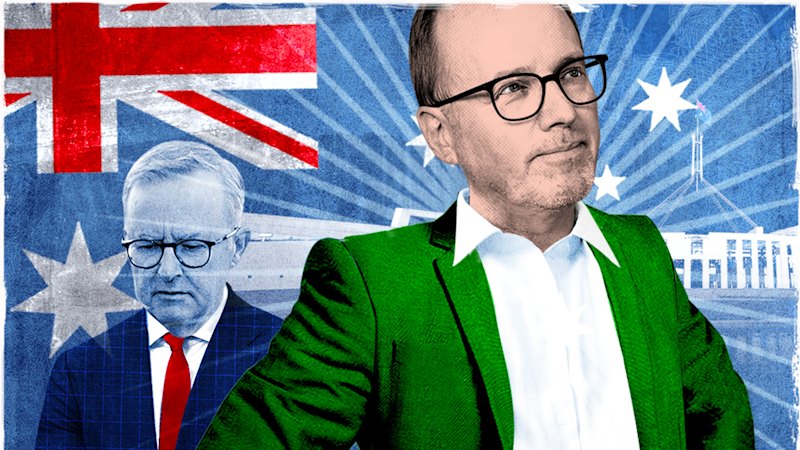
You have reached your maximum number of saved items.
Remove items from your saved list to add more.
Bookmark this week. If Labor suffers a shock catastrophe at the next federal election, there’s a good chance this will have been the inflection point.
Yes, things have been going south for a while. We’ve seen the declining polling numbers for the government, and for Anthony Albanese himself – the former most recently hitting the party’s lowest point since 2012. One Nation’s support is now baked in, and is beginning to nibble away at Labor’s margins having already sacked the Coalition’s fortresses.
For all that, though, when it comes to actual seats in the parliament, Labor has found itself in a protective cocoon of sorts. If the events of this week play out a certain way, that cocoon could be vulnerable.
I’m not just speaking of the fact that interest rates reached a 15-year high this week. Or that this news was followed by still-high inflation figures that raise the very real prospect of another rate rise in November. All this compounds the economic pain of this era, perhaps sends things to a tipping point, making the time ripe for further One Nation advances. But the wildcard, the thing that sets this week apart, is on Labor’s other political flank, where the Greens installed David Shoebridge as leader, replacing Larissa Waters, who stepped down for health reasons.
We don’t talk much about the Greens these days, which itself is telling. These are meant to be times of economic hardship and political upheaval, of the major parties in disrepute and the people in revolt. In France, often polling in second place after the far right is the New Popular Front: a coalition of communists, socialists and environmentalists. In the United Kingdom, the Greens roughly doubled their vote in the past two years before receding through the middle of this year. In the United States, the signal case is Zohran Mamdani, whose ascent to New York mayor presaged a suite of victories in Democrat primaries by democratic socialists and fellow travellers. But here? Where is the green wave?
One explanation for its absence is that under Waters, the Greens have been too quietist. Too conciliatory. Too constructive. In that view, Waters might be able to point to certain legislative achievements – on investor taxes, on national environmental laws, on native forest protections – but she never grabbed us by the throat.
This complaint often overlooks what came before: specifically that the Greens took hard lines and ran sustained campaigns on economically populist ideas, such as rent freezes, throughout the last term. They did this in a cost of living crisis and persisted right through a cost of living election. Then they lost all but one of their lower-house seats. Their most pugnacious performer, Max Chandler-Mather, who led the charge on housing, lost his seat of Griffith. Waters, then, was a response. A doer, not a blocker.
I suppose it’s possible they got this strategy exactly wrong. That they were obstructionist when people wanted solutions, and constructive when they wanted revolt: that the Greens zigged when they should have zagged. Certainly, that seems to be Shoebridge’s view. His opening salvo has been to pledge to “replace” Labor, not “reform” or work with it. He blamed Labor for the rise of One Nation. He declared war on the “1 per cent” and lambasted “incremental politics”. That’s self-consciously radical. He didn’t mention Mamdani, but he was certainly evoking him.
There are dangers in extending the Mamdani example too far. Mamdani seems a generational talent: an insurgent, perhaps, but an extremely charming and likeable one. Unlike the Greens, he is a fresh new face, not a familiar one. He comes with no accumulated baggage, no hardened impressions. Also unlike the Greens, he is attempting to remake a party of government from within, not displace it from without. And again, unlike the Greens, Mamdani arrived with Donald Trump at the levers of power, not One Nation sitting entirely outside of it. The Australian multi-party situation doesn’t map easily onto the American one, but if we must draw parallels, it’s more like when an unpopular Biden administration was in charge. And in that period, the democratic socialist movement was idling, not surging.
The better analogue for Shoebridge is not Mamdani, but British Greens leader Zack Polanski. His rise was pronounced, but off a very low base. Now, he seems to have bumped his head on a ceiling roughly where the Australian Greens are. Polanski had the advantage of being a new quantity, not a known one. As he has become more known, gravity has taken hold.
And perhaps that points to the Greens’ greatest challenge: that in an anti-establishment moment, they come across as part of the establishment. They signed agreements with prime minister Julia Gillard, helped install a carbon tax and currently hold the balance of power in the Senate (again). When they behave moderately, they are part of the system. When they behave radically, they are obstructing things. One Nation, meanwhile, has the luxury of having never been the powerbroker, which means it can sound off as it likes while obstructing nothing. It promises a cleansing fire, not gridlock.
I suspect that’s what leads Shoebridge to talk of replacement. His plea is for power, not the balance of it. Replace Labor, and you’re acting, not obstructing. It’s an enormous, unlikely ask. It might fail spectacularly, in which case Labor probably survives in some battered way. But Labor will be nervous. The orange wave is turbulent enough, but it’s survivable as long as it crashes on the walls of our cities. This week’s economic news increases the chances it might finally breach those walls from one side. And if the week’s political developments cause a green wave to swell, too, Labor might find itself inundated.
Waleed Aly is a broadcaster, author, academic and regular columnist.
The Opinion newsletter is a weekly wrap of views that will challenge, champion and inform your own. Sign up here.
Citations · 2 reports from 2 outlets
Tap a citation to read it above, right here on T.A.M.
The Greens were anti-establishment. Now it looks like they’re a part of it
David Shoebridge has taken charge of a party that was obstructionist when people wanted solutions and constructive when they wanted revolt. The Greens zigged when they should have zagged.
2 hours ago · Waleed AlyThe Greens were anti-establishment. Now it looks like they’re a part of it
David Shoebridge has taken charge of a party that was obstructionist when people wanted solutions and constructive when they wanted revolt. The Greens zigged when they should have zagged.
2 hours ago · Waleed Aly