
For years dementia researchers had no answers, but now the word ‘breakthrough’ is on their lips
A blood test that can cheaply detect the disease. Promising new treatments. These developments are game changers.
First reported 2 hours ago · latest update 2 hours ago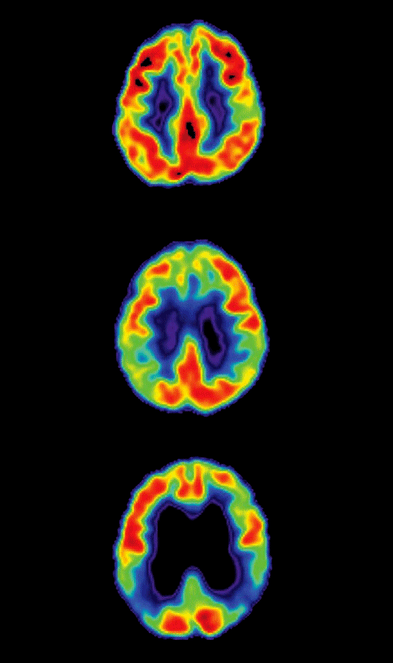
“Good things were happening [on the drug] so I think I was one of the outliers,” he said. “Sadly, it failed, so I lost access in July 2025.”
A PET scan a year later showed the amount of amyloid-beta in his brain had increased significantly since his diagnosis, despite the fact he appeared to be functioning well. This was a blow – “I thought everything I’d done had been a waste of time” – until his doctor convinced him it wasn’t the whole picture.
A lot of research focuses on the “amyloid hypothesis”, in which the accumulation of plaque around brain cells is believed to be the underlying driver for Alzheimer’s disease. It makes sense: this process begins decades before symptoms appear and stabilises about 10 years before onset.
However, there’s another important hallmark: the tau protein that becomes abnormal and tangles into stringy clumps inside brain cells, leading to disrupted pathways and cell death. This process strongly correlates with the progression of symptoms.
Under the amyloid theory, stopping the plaque attack would prevent the disease from cascading into inflammation, tau tangles and cell death.
But given the complexity and differing pathways of dementia, it may not be that simple. Queensland Brain Institute researchers are working to develop new antibodies to clear tau tangles, while a gene-silencing drug called diranersen, which lowers the body’s production of tau, has recorded a 26 per cent slowing of decline in clinical trials.
Yeates is on the frontline: he learnt just two weeks ago that he had been accepted into a new trial of a promising monoclonal antibody called MK-2214 that targets abnormal tau. After that, he hopes to get in an amyloid-beta therapy trial.
“Even if it’s false, it gives me hope,” he said. “I think that’s the most important thing: having hope.”
His multi-targeted approach make sense: amyloid and tau therapies are being trialled simultaneously on patients in the long-running Dominantly Inherited Alzheimer Network (DIAN) trials.
“The reality is for people who are symptomatic, it probably will be a combination therapy [that is most effective],” said Devenney, who is NSW’s principal investigator for the international DIAN at NeuRA.
But penetrating the brain presents a significant challenge in treatment. The blood-brain barrier is notoriously difficult to cross, meaning large doses can be required to have an effect. This is why mRNA technology – which could leapfrog the barrier and send an instruction book to cells to direct your immune system to target specific proteins – is so appealing.
At The Florey in Melbourne, Associate Professor Rebecca Nisbet is working to develop Alzheimer’s vaccines with her team. They’re drawing on the city’s trove of mRNA technology, developed during the race for a COVID vaccine.
Nisbet acknowledges monoclonal antibodies are “a massive step forward” but hearing from people living with dementia who couldn’t access clinics nor afford treatment inspired her to seek out a more accessible option.
“[A vaccine] could cost as little as $50 a dose,” she said. “Ideally, we would be aiming for self-administration but it could also be done by a GP.”
A vaccine targeting amyloid-beta has progressed most quickly and is ready to go into the next phase of clinical development.
“We were able to show all mice that were vaccinated stimulated an immune response against amyloid peptides and had reduced amyloid build-up in the brain,” Nisbet said. Despite these promising results and potential cost benefits, she is less optimistic about the next phase of funding – a concern universally shared in the field.
Clinical trials are expensive and many pharmaceutical companies are reluctant to invest, particularly after a development drought and in an environment in which US President Donald Trump speaks unfavourably about vaccines. It’s a scenario grimly known as the “Valley of Death” between promising research and commercial viability. Exacerbating the financial stress, a string of medical development grants have recently been discontinued.
Vaccines for a condition such as Alzheimer’s may seem outlandish, but there’s already evidence they may have a role. Receiving the shingles vaccine has been shown to lower the risk of older people developing dementia by 29 per cent. Intriguingly, it seems to be about more than simply dodging the virus itself: the older version of the vaccine didn’t record the same benefit. An additive that is used to boost immune response may be the hero ingredient.
“There are components of the shingles vaccine that are protective against dementia, and it’s an exciting area to explore further,” Nisbet said.
In the meantime, Kiernan suggests the age at which Australians become eligible for a free dose of the vaccine should be lowered from 65 to 50 to secure benefits before significant brain changes occur.
“You’d get your vaccine, do your bowel test and a brain check at the age of 50,” he said. “That’s what we need to work towards as a community because our economy isn’t going to be able to sustain the cost [of dementia].”
Other vaccines – including flu, pneumococcal, RSV and diphtheria, tetanus and pertussis – are also associated with a lower risk of dementia.
Repurposed drugs – developed to treat one condition but which turn out to offer benefits for other conditions – may also be part of the puzzle in dementia, in the same way aspirin use extended from painkiller to prevention of heart attacks and blood clots.
It makes sense as it is unlikely that there will be one treatment for everyone: dementia is an umbrella term for various conditions that cause loss of cognitive function, including memory.
Others include vascular dementia and Lewy body dementias, which can cause hallucinations, delusions, paranoia and anxiety. Actor Bruce Willis is among those living with frontotemporal dementia, which targets the part of the brain involved in language and behaviour.
While most research centres on Alzheimer’s, it’s common for people to have more than one type of dementia. Devenney says work is being undertaken to tackle all forms of the disease.
“We do know what the pathology is with other types of dementia,” she said. “[One] approach is more broadly to look at the overlap, look at them together and also what’s different.”
The erectile dysfunction drug Viagra has been linked to a lower risk of vascular dementia in University of Oxford research, though more research is needed. There’s a plausible mechanism: it works by improving blood flow, which is impaired in this form of the disease.
Researchers are investigating whether Riluzole, a drug used to treat motor neurone disease, could improve cognition in people with Alzheimer’s and reduce build-up of amyloid in the brain.
Hope turned to disappointment for GLP-1 drugs as a potential treatment last year after large trials found they did not slow progression of early-stage Alzheimer’s. But the drugs, which include Ozempic, Wegovy and Mounjaro, are linked to a lower risk of developing dementia among people taking them for diabetes and weight loss.
With the support of his wife, family and friends, Yeates is determined to “keep swimming” through good and bad days.
A Dementia Australia advocate, he presents at international conferences, champions the needs of people living with dementia and shares his story to reduce stigma.
“There might not be a cure,” he said. “But there can be a ray of hope that you can use to live a good life, doing the things you want to do.
“I’m optimistic for the future.”
Start the day with a summary of the day’s most important and interesting stories, analysis and insights. Sign up for our Morning Edition newsletter.
Citations · 2 reports from 2 outlets
Tap a citation to read it above, right here on T.A.M.
For years dementia researchers had no answers, but now the word ‘breakthrough’ is on their lips
A blood test that can cheaply detect the disease. Promising new treatments. These developments are game changers.
2 hours ago · Clair WeaverFor years dementia researchers had no answers, but now the word ‘breakthrough’ is on their lips
A blood test that can cheaply detect the disease. Promising new treatments. These developments are game changers.
2 hours ago · Clair Weaver