
The Sandpaper series was radioactive from the start. Then a USB stick was delivered to my room
Australia is returning to South Africa for a Test series for the first time since the ball-tampering affair. Covering the last one in 2018 was an assignment like no other.
First reported 1 hour ago · latest update 1 hour ago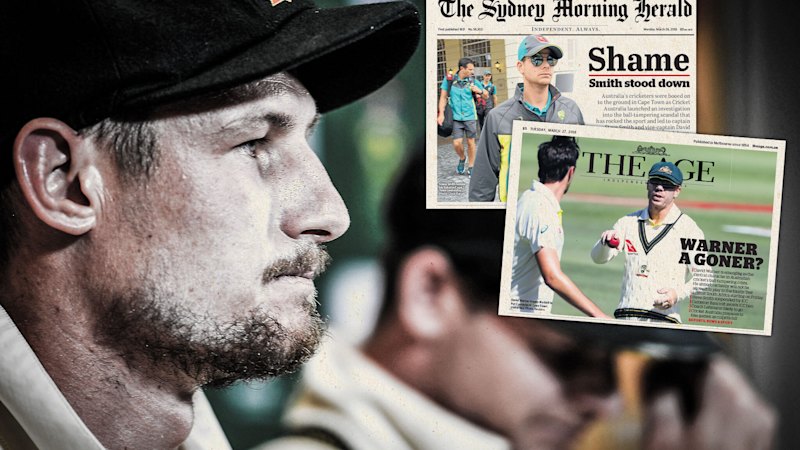
Sixteen days before Cameron Bancroft was caught hiding a piece of sandpaper down his pants, someone knocked on the door of my hotel room in Port Elizabeth, where the second Test between Australia and South Africa was about to begin.
It was about lunchtime, but I hadn’t ordered any food, and the housekeeping staff had already been around that morning.
Instead, as I got up and answered the door, I realised it was a delivery of another kind – a USB stick.
For a sports journalist covering cricket, this was not a common occurrence.
But a spiteful first Test in Durban in the preceding days had already given the impression this was not going to be your average tour.
On the thumb drive, as I discovered when I plugged it into my laptop, was unseen footage of an incident that had lit up the series just as it had begun – a stairwell clash between David Warner and South Africa wicketkeeper Quinton de Kock.
In a contest that was already brimming with tension, the clip showed the altercation from a different camera angle than the earlier leak to South African media and made for a fresh round of headlines.
I wasn’t to know that by the next leg of the tour in Cape Town, the vision would be rendered a footnote to one of cricket’s most infamous episodes.
Whenever I’m asked about reporting on the ball-tampering scandal of 2018 for the Herald and The Age in South Africa, I always remind people that Australia’s series there that year was already radioactive before it exploded at Newlands.
The days and weeks that followed the Australian team’s self-destruction on day three of the third Test were chaotic as Warner, Bancroft and captain Steve Smith were sent home.
In a piece in the hours after Bancroft was exposed, I said that the Cape Town affair was the biggest captaincy crisis since Greg Chappell told his brother Trevor to bowl underarm.
As it turned out, that was underplaying it spectacularly.
Newlands was the setting for Australian cricket to tip over the edge. The result was a reckoning for the national team, and the game.
Writing about it was an assignment like no other.
On my first night in South Africa, I was sipping a pint of Castle Lager at a hotel bar in Durban and heard that Australia wanted to have the stump microphones turned down when they were in the field.
The inference was obvious – the tourists didn’t want their on-field utterances towards the South Africans to be picked up by the viewing public as they tended to be when playing in the country, where the dial was usually kept up.
The request to Supersport, the South African network that televised the series and eventually zeroed in on Bancroft in Cape Town, was ignored.
Some in the Australian camp would later come to believe the broadcaster was weaponised against them in following the ball around as they fielded – to an ultimately devastating effect.
In Durban, Australia’s initial reaction to the stump microphones being left on was light-hearted. With some impromptu ambush marketing, they used the opportunity to promote Cricket Australia’s sponsors.
“How good is Qantas?” one player was heard saying to one of the umpires, whose sponsor was Emirates.
But it did not take long for an atmosphere of enmity to intensify, stirred up by alleged insults traded by Warner and de Kock.
The press pack was staying in the same hotel as the Australians, and I remember an annoyed Warner turning up in the breakfast room the morning after his run-in with de Kock.
Warner was not a bystander in proceedings, but he had been incensed by the gloveman’s alleged sledging about his wife Candice and strongly denied directing personal and family-related barbs of his own towards de Kock.
There was brief calm after we flew to Port Elizabeth for the second Test. The Australians brought with them a 1-0 lead, and Mitchell Marsh led morning dips in the surf opposite their luxury beachside lodgings.
But it did not take long for the hostility to ramp back up again. I just about fell off my chair in the press box at St George’s Park just after stumps one day when a source texted a photo of South African cricket officials posing with spectators wearing Sonny Bill Williams masks.
It took the heckling of Warner’s wife to a new level, who had many years earlier had a dalliance with the cross-code football star and was in the crowd with her and Warner’s two young daughters.
South African paceman Kagiso Rabada’s shoving of Australian captain Steve Smith after dismissing him had further flared tempers, and in a harbinger of things to come, distrust was also building about the two teams’ production of reverse swing – and how they were achieving it.
So much had gone on that by the time South Africa won in Port Elizabeth, levelling the series 1-1, the other Australian reporters and I took a collective breath as we paid a visit to the Addo Elephant National Park, thinking that the tour had surely hit its quota of nastiness and notoriety.
A nine-day break before the third Test in Cape Town put some distance between the rivals and offered those of us writing about them some downtime to explore the city and its surroundings.
We spent a few mornings climbing Table Mountain and Lion’s Head, visited Robben Island, where Nelson Mandela was once imprisoned, and joined team media manager Kate Hutchison and security manager Frank Dimasi for lunch at a winery in Stellenbosch.
I don’t know if Kate had access to a crystal ball, but as we gorged ourselves on a four-course meal and took in the view of the surrounding mountain ranges, she told us she had decided to move on from the often gruelling job after the tour.
When we got to Newlands, we sat down with Smith in a couple of rows of uncovered seating at the ground. He admitted he was tired after the Ashes in the previous Australian summer. He was also irritated by Rabada’s surprise exoneration for shoulder barging him, questioning why he wasn’t called as a witness to the appeal hearing, as well as a claim on South African bowler Vernon Philander’s social media account that he had taken a dive. Smith was not amused at Philander’s insistence that he had been hacked.
The Cape Town Test featured more abuse of players’ partners from beyond the boundary and a verbal run-in between Warner and a crowd member after he was bowled by Rabada in the first innings.
When I asked coach Darren Lehmann about the targeting of families in a press conference on the second evening, he called it “disgraceful”. It was a word that would be coined widely for what took place 40 minutes after lunch the next day.
This is burying the lede a little, but when the cheating storm blew up on the third afternoon at Newlands, I wasn’t there.
There is an unofficial rule imposed from sports desks that unless you’ve lost an arm you turn up at the ground, and I hadn’t missed a day’s play in the seven years I had been covering the Australian team.
My limbs were intact (as were those of colleagues who had swum with great white sharks in the gap between Tests), but on that day of days I was back at the hotel in the city centre, struck down by gastro and reporting on the match off the television.
Some of the Australian tour party had been isolated with the same illness, and we’d been asked not to show up if we caught it.
It was unfortunate timing for me, and I’ve never been thrilled about it, but there was a benefit to watching and listening to it all play out on the screen. As those who were sitting up late in Australia might remember, there was a build-up to the incident itself as the commentators made clear they suspected something was going on.
When it became obvious there was, I realised I would need to shake off the sickness and strap myself in for the rollercoaster that was to come.
It began with Smith and Bancroft’s infamous post-play press conference, which they had been advised not to attend, and the firestorm that erupted when Australia woke up.
The next morning I got myself across to the team’s nearby hotel, the Southern Sun Cullinan, to scope out what intelligence I could. I was also tasked with capturing a photo for the next day’s front page so, armed with my iPhone 6, I took one of an ashen-faced Smith walking to the team bus as the team made their way back to the ground.
The shell shocked Australians were bowled out for 107 to lose the Test, but I don’t remember a ball of it, with attention fixed entirely on the underhanded tactics of the day before, who was behind them and what would happen next.
In a frenzy of phone calls to contacts in South Africa and Australia, I recall a feeling of trepidation as I sent in a story the next day saying that Warner was being cast as the chief conspirator and he and Smith were facing bans, even though I was sure of the information.
That anxiety was nothing, though, compared to the panic coursing through me when I set off soon after for the final destination of the tour, Johannesburg, but was told at Cape Town airport that I had been placed on standby for my flight because it was overbooked.
Cricket Australia chief executive James Sutherland had flown into Johannesburg from Melbourne and was due to front a press conference at which it was thought he would announce sanctions against the players. I would miss it for sure if I had to wait for another plane.
As I fretted about being in the wrong place at the wrong time again, it emerged that Warner had been booted out of the team’s WhatsApp. After confirming that was right with a couple of phone calls, I sat on an unused old plastic chair in the terminal and frantically thrashed out an article.
Thankfully, there was a no-show or two at the airport, and after keeping an eye out for any late-arriving passengers running towards the check-in counter, I was relieved when the airline staff called me over to tell me I had a seat and I made it in time.
As it turned out, Sutherland didn’t reveal the suspensions imposed on Smith, Warner and Bancroft at his presser. That came a day later, landing with a thud via email from Cricket Australia.
The media contingent had by then taken up residency in the foyer of the team’s Johannesburg hotel and we looked on as Smith farewelled teammates and wheeled his suitcase out to a waiting vehicle. Warner was nowhere to be seen. He had slipped out more quietly to the airport with his family.
The story, of course, did not slow down with their departures.
There were suggestions the banned trio might take their cases to a hearing, and Warner’s representatives requested transcripts from the interviews conducted during the Cricket Australia investigation in Cape Town.
Then there was Smith’s heart-wrenching press conference on arrival in Sydney and Bancroft and Warner’s own emotional public mea culpas.
There was still another match to play, too, with a new captain, Tim Paine, and a new-look team and more tears to come.
Lehmann announced on the day before the fourth Test that he was quitting, then in surreal scenes the team trained to the strains of Australian classic songs at top volume around the cauldron that is the Wanderers ground. The fact that one of the tunes was Reckless, by Australian Crawl, did not go unnoticed.
The match itself, which South Africa won by 492 runs to win the series 3-1, was the kind of pummelling to be expected when the Australians’ minds were elsewhere.
The Australian team would pick themselves up – I was lucky enough to be at Edgbaston the following year to watch Smith lead them to victory with his remarkable twin hundreds in the first Ashes Test. Warner and Bancroft were also back in the team.
While they paid a heavy price for their mistakes, their careers went on. Smith is still in the team, has been captain again, and will be in the line-up against South Africa in Durban this week for Australia’s first Test in the country in eight years.
Even so, the events of South Africa in 2018 left a lasting impression for those three and everyone else involved.
In many ways, it was the series the spirit of cricket forgot.
Those of us who were there will certainly never forget it.
News, results and expert analysis from the weekend of sport are sent every Friday. Sign up for our Sport newsletter.
You have reached your maximum number of saved items.
Remove items from your saved list to add more.
Citations · 2 reports from 2 outlets
Tap a citation to read it above, right here on T.A.M.
The Sandpaper series was radioactive from the start. Then a USB stick was delivered to my room
Australia is returning to South Africa for a Test series for the first time since the ball-tampering affair. Covering the last one in 2018 was an assignment like no other.
1 hour ago · Chris BarrettThe Sandpaper series was radioactive from the start. Then a USB stick was delivered to my room
Australia is returning to South Africa for a Test series for the first time since the ball-tampering affair. Covering the last one in 2018 was an assignment like no other.
1 hour ago · Chris Barrett