
Tech entrepreneur Ruslan Kogan prefers family meals over fine dining
Australian tech founder Ruslan Kogan, whose companies have generated roughly $300 million, says his favorite place to eat is his mother’s dining table, reflecting on his immigrant background and success.
First reported 1 hour ago · latest update 1 hour ago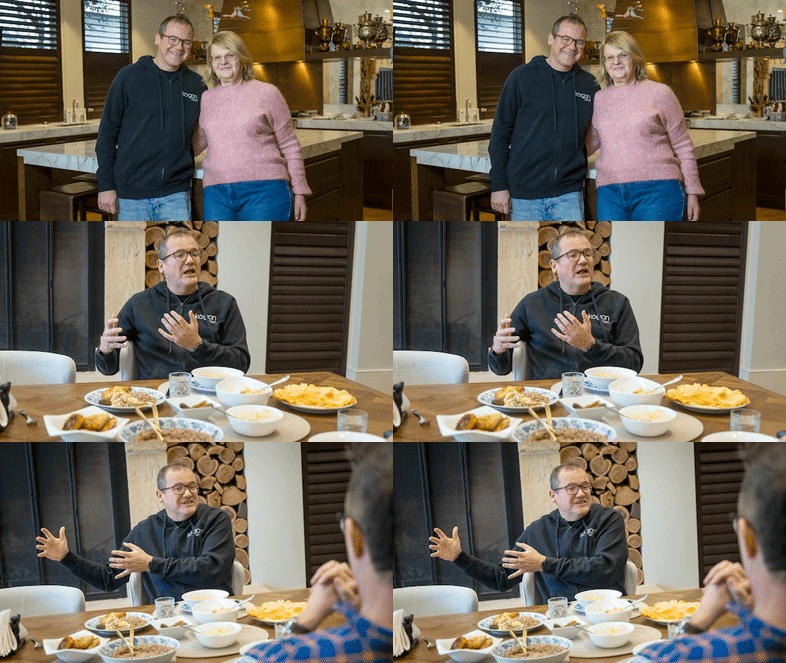
At lunch, I am on unfamiliar but comforting terrain. After the soup, a plate arrives artfully arranged by Anastasia. The kotleti chicken cutlets – moist and tender pan-fried patties are lightly flavoured and pure comfort food. Alongside are a couple of pickles, a spread of nutty buckwheat, and a thick dollop of Olivier salad (comprising diced boiled potatoes, peas, carrots and mayonnaise, and richer and tangier than a standard potato salad). Nalisniki – crêpes with jam – follow for dessert.
Kogan’s schoolmates from government-run selective Melbourne High School like to observe his ability to amiably move through vastly different socio-economic worlds. But moving to Toorak, with Anastasia in 2018, two years after kogan.com floated on the stock market, required adjustment.
“There’s lots of bits about it that I don’t like,” he says of his adopted suburb.
“Everyone’s got really tall fences. There’s very little interaction as a community.
“I remember when we moved in, we printed off pamphlets saying, ‘Hey, we’re moving in. We really look forward to being part of this community. Here’s a photo of our dog. We would love to meet you’.”
They received one response.
In 2010, fast on his way to becoming Australia’s richest person under 30, Ruslan Kogan was out drinking with mates at Justin Hemmes’ Ivy bar in Sydney, when he spotted a woman in the bar he was convinced was Russian.
“I was pretty drunk, and I walked up and said, ‘I can tell with 100 per cent certainty you’re Russian’,” he recalls.
Anastasia replied: “I can tell with 100 per cent certainty you’re an idiot.”
Kogan now says: “I think with that quick quirky comeback she had me. I was right about the Russian, she was right about the idiot.”
Fast forward 16 years later and the couple have two young daughters and a son. Kogan says he and Anastasia have a lot in common but are very different.
“I’m more like, take me to a factory and show me how door handles are made. Whereas … she’ll be like, ‘We can’t go to Paris without the Louvre’.
“I’ll be there complaining this isn’t a good place to take a four-year-old and a two-year-old and a one-year-old, but she still forces us to do it.”
At one point Kogan talks about his birthplace while talking about his Toorak neighbours.
“I was born in a shithole little town called Babruysk, and” – here he waves over the fence – “that’s a family with heritage from about 50 kilometres down the road, an incredible retail family that built an incredible business. But through some businesses being asleep at the wheel, we were able to build a significant business in Australian online retail.”
Kogan is talking about the Myer retail family. Patriarch Sidney Myer was born in Belarus in 1878 to a Jewish family before immigrating to Australia in 1899 and founding the Myer retail empire.
Has he met any of the Myers, I wonder? “No.”
The COVID-19 lockdowns were wild for kogan.com. The company rode its zenith and nadir along with online buyers trapped at home. At one stage, the business’s market capitalisation was more than 10 times the size of Myer. But the comedown was painful, the company massively overstocked, and it created a business crisis as it had to slash prices. The market cap of both companies is now similar.
But Kogan prefers the future and believes in artificial intelligence, so much so that he deploys an AI avatar to give annual result presentations to investors. A more efficient use of his time, he says, is doing away with the need to re-record his presentation when market forecasts change. And AI will help customers searching for a deal to find the Kogan website, he believes.
“Not only are we surviving. Yeah. We’re thriving.We are winning market share against global organisations who are many times bigger than us.”
Kogan stays out of politics, though he called for a royal commission into the Bondi massacre, but his rise to business prominence has not been without controversy. He has a long-standing feud with rival retailer Gerry Harvey, and Kogan once labelled “work from home” as “wanking from home”.
He says that at school, “I was always getting top marks, but there were very few teachers who liked me” and his reputation was as a disruptive class clown.
“I think a lot of truth is said in jests,” he muses.
Then there was his controversial “ball-tampering” joke, which tied the Australian cricket team sandpaper scandal to celebrity trans woman Caitlyn Jenner, who was born a biological male Bruce Jenner.
“What I thought, it was a bit of fun, but there were a few people offended by it,” he says.
How does he feel about it now? He pauses and looks out over the manicured lawn.
“My parents went through a lot of shit to escape a place without freedom of speech,” he replies.
He admits that he may well have done a bad job of trying to be funny.
“That’s one of the leading indicators to a decline in a free society ... when comedians need to start apologising.”
Citations · 2 reports from 2 outlets
Tap a citation to read it above, right here on T.A.M.
Ruslan Kogan made $300m in tech. But his favourite place to eat is his mother’s dining table
The multimillionaire tech founder bypasses fine dining to break bread at his mum’s home, reflecting on his journey from 1980s Soviet immigrant to Toorak-based retail giant.
1 hour ago · Stephen BrookRuslan Kogan made $300m in tech. But his favourite place to eat is his mother’s dining table
The multimillionaire tech founder bypasses fine dining to break bread at his mum’s home, reflecting on his journey from 1980s Soviet immigrant to Toorak-based retail giant.
1 hour ago · Stephen Brook