
France and Germany propose new trade measures targeting China, likened to a ‘trade bazooka’
Australian publications describe a joint European initiative where France and Germany suggest cutting off China from its largest market unless it alters certain practices. The story focuses on the proposed measures without reporting any contradictory details.
First reported 1 hour ago · latest update 1 hour ago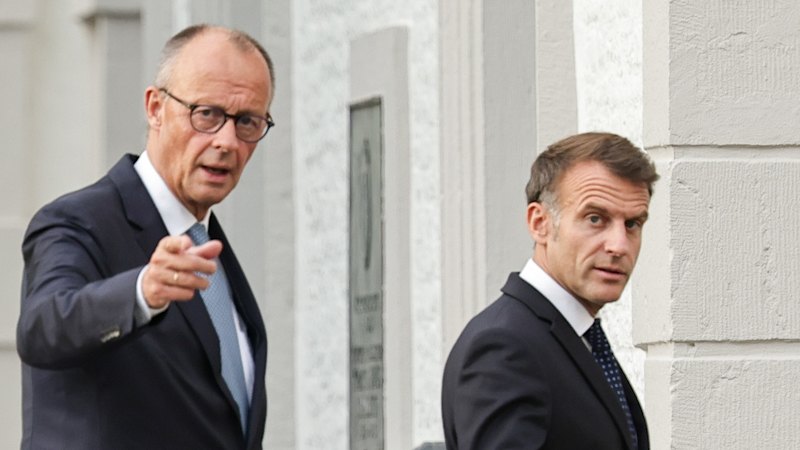
You have reached your maximum number of saved items.
Remove items from your saved list to add more.
You've used all of your gift articles. 3 more will become available on the 1st of every month.
A delegation of European Union trade negotiators is in Beijing, hoping to avert what could be a full-scale trade confrontation with China.
The talks on Thursday and Friday between a team headed by EU Trade Commissioner Maros Sefcovic and his Chinese counterpart Wang Wentao are taking place amid Europe’s fears that a swelling flood of cheap Chinese imports is de-industrialising its economies.
Last year, China’s trade surplus with the EU was €360.6 billion ($580 billion). So far this year, China’s exports to the EU are up 15 per cent and the surplus has swollen by as much as 23 per cent. Sefcovic has called the widening trade imbalance “unsustainable” and a threat to Europe’s social model.
The increasing concerns about the unbalanced trade relationship have brought about an unlikely alliance between France, traditionally one of the more protectionist of the major European countries, and Germany, historically a free trader and opponent of measures to restrict imports from China.
With imports of Chinese electric vehicles and plug-in hybrids cutting a swathe through the German auto industry – Volkswagen has recently announced the closure of four of its major factories, with about 100,000 of job losses – German Chancellor Friedrich Merz has joined France’s Emmanuel Macron in calling for the creation of a new “last resort” trade instrument that could instantly cut off access to the EU market.
That’s a major shift in Germany’s stance. Historically, it opposed trade restrictions because it was a major exporter to China and its companies had invested heavily in China’s industries via joint ventures. Now its own industries are being decimated by an industrial base it helped develop.
The letter sent by Macron and Merz to European Commission (EC) president Ursula von der Leyen on Monday implored her to expand the EU’s arsenal of trade weapons in response to the increased “weaponisation of trade, systemic market-distorting practices and global macroeconomic imbalances”.
The EU already has what has been described as its “trade bazooka” – its anti-coercion instrument – but has never used it. That instrument allows EU officials to impose tariffs and other trade restrictions if they determine another government is using economic coercion against the bloc.
The move, however, requires the support of more than half the EU’s 27 member countries representing at least 65 per cent of the EU population, which is a steep hurdle.
Merz and Macron’s proposed new instrument could be activated instantly by the EC, unless the member states voted to revoke it, lowering the hurdle. It would also allow the EC to move far quicker.
France and Germany also proposed a “diversification” instrument, which would let the EC impose a cap on the percentage of imports from one country allowed in various product categories.
The obvious concern for France, Germany and the rest of the EU is that if they were to restrict Chinese imports or increase tariffs on them, China would respond by cutting off access to strategic minerals like rare earths and magnets, where it has introduced a licensing system. The new tool would give the EC the ability to shut China out of its biggest and richest market.
In effect, the European leaders are seeking to create something akin to the Section 301 powers that Donald Trump has invoked in the US to recreate the global tariff regime knocked out by the US Supreme Court earlier this year.
That section of the US Trade Act gives a president the authority to impose trade penalties in response to unfair trade practices.
The current flashpoint in the EU-China relationship is the devastation of the European car industry by China’s electric vehicle and, more particularly, plug-in hybrid manufacturers.
Only two years ago, the EU imposed tariffs ranging from 7.8 to 35.3 per cent – on top of a general 10 per cent tariff on imported cars – on Chinese EVs. But the duties didn’t cover plug-in hybrids, where EU imports more than doubled last year. This year, Chinese hybrids account for almost half of all new EU sales of plug-ins.
It’s not just electric cars, however. Europe’s green technology, steel, chemicals, pharmaceuticals, machine tools and aerospace sectors are also being swamped by Chinese imports. Even the UK, albeit under the threat of facing restrictions to its own trade with the EU, is considering imposing hefty tariffs on imports of cars and chemicals from China.
The EU also wants China to lower some of its own tariff and non-tariff barriers to EU imports.
China will, of course, resist the European pressure. And it has its own powerful trade instrument – cutting off access to the rare earths and magnets vital to most advanced manufactures.
It might, however, be prepared to make some concessions rather than risk being shut out of its key developed world market entirely. Sacrificing its value-added tax rebate for exported EVs might be a start, knowing that the sprawling and disparate nature of the EU membership makes it difficult to build consensus for anything even mildly controversial. A ban on imports from China, or caps on its market shares, would be tricky to achieve.
There’s also the larger picture. America decided during Trump’s first term that China was using unfair tactics – state and local government subsidies, below-market finance and central direction to dominate strategic sectors – and began the initial trade war.
Unfortunately, Trump’s fixation on tariffs meant he extended the trade war to the rest of the world in his second term, alienating many of America’s closest allies that might have joined the US in pressuring China to change its ways.
There’s good reason for the EU and other economies that, like Australia, are open and dependent on a relatively free global trading environment to be concerned about China’s exports.
The collapse of China’s property market more than five years ago has undermined its domestic economy, leaving it increasingly reliant on exports to drive economic growth.
Beijing has resisted external calls for a major stimulus program to drive greater domestic consumption and domestic growth, which has led to significant over-capacity relative to the weak domestic demand – and a tide of exports as its companies redirect their sales.
Last year China had a trade surplus of about $US1.2 trillion ($1.7 trillion), or about four times its surplus in 2020. This year it is on track to generate an even bigger surplus.
It’s not just the dollar value of its exports, but export volumes that are climbing at a steeper rate than their value. China is selling/dumping more product at ever-cheaper prices into the global market, much of it in Europe.
Whether or not the EU does make a stand, China’s strategy was inevitably going to produce a backlash, one that could eventually threaten its export-driven growth and its economic stability.
Trump has been leading the assault on the free trade environment, which enabled Beijing’s “Made in China 2025” strategy of incentivising development of advanced manufacturing with the ambition, now nearly realised, of global dominance of strategic sectors and their supply chains.
The risk for China is that if it continues to wipe out other countries’ manufacturing sectors and jobs, others might hold their noses and join the protectionist US president.
The Market Recap newsletter is a wrap of the day’s trading. Get it each weekday afternoon.
Citations · 2 reports from 2 outlets
Tap a citation to read it above, right here on T.A.M.
Europe raids Trump’s tool box for new ‘trade bazooka’ against China
France and Germany have proposed measures that could cut China off its biggest and richest market if it doesn’t change its ways.
1 hour ago · Stephen BartholomeuszEurope raids Trump’s tool box for new ‘trade bazooka’ against China
France and Germany have proposed measures that could cut China off its biggest and richest market if it doesn’t change its ways.
1 hour ago · Stephen Bartholomeusz