
France’s 10 greatest villages, ranked and rated
Forget the blindingly obvious, sometimes the most charming places are hidden gems.
First reported 2 hours ago · latest update 2 hours ago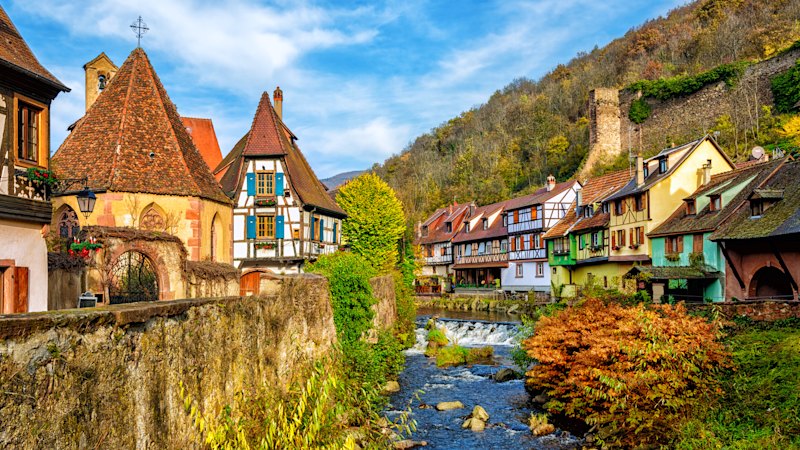
Alsace gets a kicking whenever Latin and Germanic worlds come to blows. Locals have thus taken refuge in epic domesticity rooted in hard work, fraternity and unflagging festivity. The result, notably along the wine route, is a succession of half-timbered villages overcome with flowers and joie de vivre, all the while wearing Sunday best.
Most seductive is Kaysersberg, its wonky cobbled streets winding blithely below the vine-covered slopes of the incipient Vosges mountains. Up top is forest and what’s left of the imperial chateau, down below the birthplace of Albert Schweitzer, theologian, organist, musicologist, writer, humanitarian, philosopher, Nobel Peace Prize winner and doctor – among the greatest men of the 20th century. He was born in Kaysersberg. His birth house reopened in 2023 as the Schweitzer Centre Museum celebrating his life, thought and dedication to peace; entry $11.
Where to stay: The magnificent Chambard has double rooms from $427 and, under the commands of Oliver Nasti, one of Alsace’s finest tables. It is double Michelin-starred, so don’t be surprised by a five-course dinner menu at $459. The associated, traditionally Alsacien, winstub (brasserie) is much more affordable, with mains from $53.
How to get there: Either drive (Calais to Kaysersberg is six hours 30 minutes) or train it to Paris, then take the TGV Est to Strasbourg. The full journey should take slightly over five hours. Now take the train to Colmar and switch to the bus for the last leg – about 90 minutes in all.
This astonishing spot grows directly out of a rocky promontory almost entirely encircled by gorges meeting in a vortex of vertigo. Apart from houses which teeter on the edge – mothers must have palpitations – slaughter is the village’s key claim to fame. The 1210 papal crusade against Cathars bade village heretics to renounce Catharism or die. Three gave in; 140 walked out of the town gate directly to be burned at the stake.
These days light and heat of centuries pours out of the huge sky onto dense scrub, rock and patches of vineyard – and the village crams in upon itself to shelter. Stroll the streets and you might just be strolling the 13th century.
Minerve, of course, gives its name to the Minervois appellation wines, among the most interesting from Languedoc. There’s a minerality about them which reflects their origins. For proof, call in at Domaine Cavailles at 2 Grand Rue in the village centre. The red cuvées Coralie and Jeannot, at around $11-$13, are remarkable value.
Where to stay: In the heart of the village, the Hotel Relais Chantovent has simple double rooms at $98. Its first-rate restaurant oversees the gorges, with dinner menus from $57.
How to get there: Fly to Beziers or Carcassonne. There’s an onward drive of about an hour from both.
In the Ubaye valley, Barcelonnette is so purely Alpine – mountains, surging river, crags, skiing – that you expect vigorous yodelling. So wherefore the mariachis? What’s all this Mexicana? The Hotel Azteca? Adelita Mexican restaurant? The Baita boutique with more Mexican stuff than they have in Oaxaca? A Mexican consulate, for heaven’s sake? Simple.
Folk from the surging Ubaye valley traded far and wide. Notably, by the late 19th century, over and away into Mexico, where they controlled 90 per cent of the textile business, and some 27 per cent of foreign investment. The exiles sent money home, or themselves came back rich, established fancy villas (and equally fancy tombs) – and lasting links with Mexico. The tale is well told in Barcelonnette’s recently refurbed Musee de la Vallee. The Fêtes Latino-Mexicaines celebrates Barcelonnette’s Mexican connections every August. Mariachis, sombreros and dancers in dipping dresses abound. There’s Mexican food, theatre, concerts, ballet and much else besides (August 7-16, 2026).
Where to stay: If you’re going to do the Mexican job properly, you need the four-star, arty Hotel Azteca. It has doubles from $162.
How to get there: Fly to Nice then hire a car. It’s three hours to Barcelonnette.
I choose Bagnoles not because it’s a celebrated spa town (though it is: Roumanian royalty were regulars). It is, rather, for the associated, raffishly elegant Belle Epoque aspect which all self-respecting spa towns wear. This is a French version of Leamington Spa, but with its hat at a more rakish angle. Built round a lake as big as the village, Bagnoles is more garden than town, and more forest than either. It’s edged by 18,000 acres of beech, oak, spruce, rocks and much else besides.
As I do, US billionaire Frank Jay Gould thought the place delightful. He invested much of his crooked dad’s railway fortune in a casino and Grand Hotel. He expected gratitude, didn’t get it, so cleared off to establish Juan-les-Pins on the Riviera. Bagnoles has, though, got on pretty well without him, a seam of Edwardian charm running through to right now.
Just out of town, the Manoir du Lys nestles in the Andaine Forest, a manorial hotel with a formidable gastronomic reputation. Chef Franck Quinton probably knows as much about mushrooms as any person alive. Doubles from $196; three-course dinner menus from $160.
Where to stay: Slightly more modest, bang in the village centre – and much lovelier inside than it looks from the outside – Hotel Beryl is as friendly as it gets. Overlooking the lake, it has a spa and double rooms from $212; the three-course menu is from $49.
How to get there: Ferry to Ouistreham with Brittany Ferries and then it’s 90 minutes to Bagnoles.
Unravelling down its rocky promontory way above the River Lot, Saint-Cirq-Lapopie is a marvel of vertical stone streets and surrealism – a work-out for both the thighs and the mind. There’s barely a flat bit to be had as one roams a spot which has been hanging on – physically and figuratively – for centuries. Once famed for its castle and the production of wooden taps for barrels, it is these days set up to receive visitors – don’t wear heels, for heaven’s sake – and pilgrims to a temple of surrealism.
This is the 13th-century tower house of André Breton, kingpin of surrealism. It’s presently the International Centre for Surrealism and World Citizenship. Later, you might focus on the ruins of the vertiginous castle, and on the church. Note the statue of local lad St Jean-Gabriel Perboyre, strangled on a cross while a missionary in Wuhan, China. The atmospheric sense of a solid past has absolutely survived into the tourist times of the 21st century.
Where to stay: At the foot of the village, the Hotel-Spa Le Saint Cirq is a classy base for both the village and the Lot valley. President and Mrs Macron have been there a time or two. Doubles from $160.
How to get there: Fly Stansted to Rodez and hire a car for the 90-minute drive to St- Cirq.
“My only regret,” said the ageing Maynard Keynes, “is that I haven’t drunk enough champagne.” It’s not a risk worth taking, so travel to the region. The big posh houses gather in Reims and Epernay – but the heart of the matter is out in the villages where family operations create independent champagnes in cellars dug out by great grandad with a pick-axe.
Prettiest of all is Hautvillers, base to 17th-century monk Dom Perignon. He didn’t (as claimed) invent champagne, but certainly improved it. Stroll to his tomb in the village church along sunny white-stone streets hung with wrought-iron signs. Then stroll back to Champagne G Tribaut whose vines sweep down to the River Marne with Renaissance rightness. The Cuvee de Reserve is a steal at $36.
Where to stay: La Chevalee chambres-d’hotes with the Fedyk champagne-making family has – as you’d expect – classy double rooms, suites really, from $360, including breakfast.
How to get there: Best bet is to take your own car – you’ll need to fill up the boot. Calais to Hautvillers is a little under three hours.
Citations · 2 reports from 2 outlets
Tap a citation to read it above, right here on T.A.M.
France’s 10 greatest villages, ranked and rated
Forget the blindingly obvious, sometimes the most charming places are hidden gems.
2 hours ago · Anthony PeregrineFrance’s 10 greatest villages, ranked and rated
Forget the blindingly obvious, sometimes the most charming places are hidden gems.
2 hours ago · Anthony Peregrine